

 PDF Version Demo
Simulation for the software version
Since you are a clever person, you must be aware of the fact that simulation plays a very important part in the success of the test, Through simulating in the 642-437 actual exam materials, you can have a better understanding of the procedure of the test, and thus you will be unlikely to be at loss when you have suddenly encountered something totally out of your expectation in the Cisco 642-437 real test. In addition, there will no possibility for you to be under great pressure to deal with the questions occurring in the test. Just as what has been universally acknowledged, it is the last straw that has cracked down the clever person. And I want to say pressure can definitely be referred to as the last straw. However, with the help of our 642-437 actual exam materials, you can protect yourself from being subjected to any terrible pressure. Fantastic! Isn't it?
Instant Download: Upon successful payment, Our systems will automatically send the product you have purchased to your mailbox by email. (If not received within 12 hours, please contact us. Note: don't forget to check your spam.)
Free renewal for one year
To cater to the demands of the majority of population who likes to enjoy preferential when making a purchase for goods, our 642-437 exam guide materials offer free renewal of exam trainings in one year so that every customer who buys our 642-437 practice exam questions will have free access to the renewal to their hearts' content. Isn't it an impressive thing to deal with this kind of exam? What's more, our 642-437 actual exam materials provide our customers with many discounts, whether they are old customers or new. Compared with other exam trainings which are engaged in the question making, our 642-437 exam guide materials do outweigh all others concerning this aspect.
With the passage of time, more and more people have come to realize the importance of Cisco 642-437 exam. Therefore, they put high premium on the exams, hoping to win great success in the future career by passing the targeted exams. However, it is not always a piece of cake for them without appropriate learning tools. But all of these can be possible with our 642-437 actual exam training files. The reasons are as follows.

Fast learning of customers
You must have experienced the feelings of being envious to those seeming talents who can get the hang of the core of something in such a short moment that you even cannot image. Now, you don't need to suffer from this miserable situation because you can become such a person too once you have used our 642-437 practice exam questions. The reason why the customers can gain the ability to have a quick comprehension to what is printed or said is that our 642-437 actual exam materials are attached by clear interpretation for some extremely difficult questions. And as you know, difficult questions of 642-437 exam guide are always so complex because they are intertwined with all kinds of small questions, so much as to be a kaleidoscope. Therefore, after you have found out the main thread of the method for these difficult questions, all those small problems will be readily solved. Perhaps this is also the reason why our 642-437 practice exam questions have witnessed the ever-progressive development in the international arena.
Cisco 642-437 Exam Syllabus Topics:
| Section | Objectives |
|---|---|
| Signaling and Call Control | - Dial plans and call routing - SIP, H.323, and MGCP protocols - Gateways and gatekeepers |
| Troubleshooting and Operations | - Voice and QoS troubleshooting methodologies - Common VoIP deployment issues |
| Quality of Service (QoS) | - QoS models and mechanisms - Congestion management and avoidance - Traffic classification and marking - Queuing techniques and bandwidth management |
| Call Admission Control and Performance | - Voice network performance considerations - Call admission control mechanisms |
| VoIP Fundamentals | - Voice traffic signaling basics - Voice over IP architecture and components - Voice codecs and compression techniques |
Cisco Implementing Cisco Unified Communications Voice over IP and QoS v8.0 (CVOICE v8.0) Sample Questions:
Which two commands should you use on a common gateway between the two IP telephony networks to enable SIP to H.323 interworking? (Choose two.)
- A. allow-connections h323 to sip
- B. voice service sip to h323
- C. voice service h323 to sip
- D. allow-connections sip to h323
Correct Answer: A,D 🗳️
Refer to the exhibit.
Cisco 642-437 Exam
What happens when users at Site B place calls to Site A when the IP WAN is operational?
- A. The calls will always take the PSTN route.
- B. The calls will always take the IP WAN route.
- C. The calls will use the IP WAN route unless there is a failure or congestion during which the calls will reroute via the PSTN.
- D. The calls will use round-robin scheduling between the IP WAN and PSTN paths.
- E. The calls will fail because the destination patterns are identical.
Correct Answer: D 🗳️
Refer to the exhibit.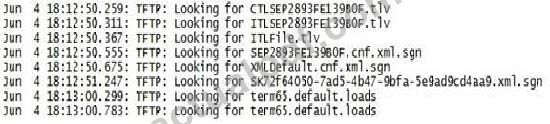
A new Cisco Unified Communications Manager Express system has been deployed and the technician is trying to add the first new IP phone to the system. The phone powers up, but it does not register with the system. The technician has verified that the phone is getting the proper VLAN information from Cisco Discovery Protocol. The phone is also getting the correct IP address and TFTP server address from DHCP. The phone has been assigned to an ephone and the correct MAC address is configured. With the information provided, which two of the following does the administrator need to verify to resolve this situation? (Choose two.)
- A. Verify that the Cisco Unified Communications Manager Express service is running.
- B. Verify that the ip helper-address is correctly configured.
- C. Verify that telephony-service has been configured.
- D. Verify that the ephone has a button assigned.
- E. Verify that the correct phone type files are in the tftp-server path.
- F. Verify that the tftp-server path has been configured.
Correct Answer: E,F 🗳️
Explanation: Only visible for ActualPDF members. You can sign-up / login (it's free).
Which QoS mechanism for VoIP works with weighted fair queuing (WFQ) and class-based weighted fair queuing (CBWFQ)?
- A. Multilink PPP
- B. FRF.12
- C. Header compression
- D. RSVP
- E. IP RTP Priority and Frame Relay IP RTP Priority
Correct Answer: E 🗳️
DRAG DROP
The voice gateway selects an inbound VoIP dial peer by matching the information elements in the setup message with the dial peer attributes. From the list on the left, drag the elements to the right and drop them in the order in which a voice gateway matches inbound calls. Not all options are used.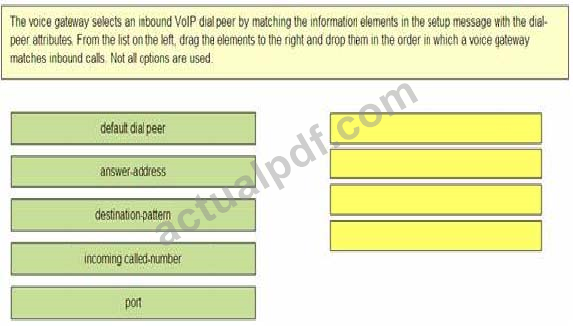
Correct Answer:

Explanation: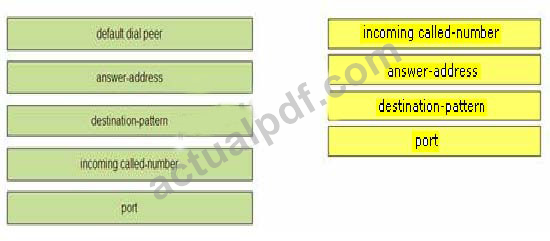
Inbound Dial Peers Matching Process
When the Cisco IOS router or gateway receives a call setup request, a dial peer match is made for
the incoming call in order to facilitate routing the call to different session applications. This is not a
digit-by-digit match; rather the full digit string received in the setup request is used to match
against configured dial peers. The router or gateway matches the information elements in the
setup message with the dial peer attributes to select an inbound dial peer. The router or gateway
matches these items in this order:
Called number (DNIS) with the incoming called-number command:
First, the router or gateway attempts to match the called number of the call setup request with the
configured incoming called-number of each dial peer. Because call setups always include DNIS
information, it is recommended to use the incoming called-number command for inbound dial peer
matching. This attribute has matching priority over the answer-address and destination-pattern
commands.
Calling Number (ANI) with the answer-address command:
If no match is found in step 1, the router or gateway attempts to match the calling number of the
call setup request with the answer-address of each dial peer. This attribute can be useful in
situations where you want to match calls based on the calling number (originating).
Calling Number (ANI) with the destination-pattern command:
If no match is found in step 2, the router or gateway attempts to match the calling number of the
call setup request to the destination-pattern of each dial peer. For more information about this, see
the first bullet in the Dial Peer Additional Information section of this document.
Voice-port (associated with the incoming call setup request) with configured dial peer port
(applicable for inbound POTS call legs):
If no match is found in the step 3, the router or gateway attempts to match the configured dial peer
port to the voice-port associated with the incoming call. If multiple dial peers have the same port
configured, the dial peer first added in the configuration is matched.
If no match is found in the first four steps, then the default dial peer 0 command is used.
http://www.cisco.com/en/US/tech/tk652/tk90/technologies_tech_note09186a008010fed1.shtml#co
nv
Viewing page 1 out of 52 pages.
Viewing questions 1-5 out of 257 questions.


