

[Mar 01, 2026] Free Oracle Database 19c 1Z0-083 Official Cert Guide PDF Download
Oracle 1Z0-083 Official Cert Guide PDF
NEW QUESTION # 33
Which two are true about the execution of operating system scripts starting from Oracle Database 19c? (Choose two.)
- A. The sudo password must be specified in a response file.
- B. The root password cannot be specified in a response file.
- C. orainstRoot.sh can be executed automatically by the Database installer by using sudo or root credentials.
- D. root.sh can be executed automatically by the Database Installer only if it is provided with root credentials.
- E. root.sh can be executed automatically by the Database installer only by using sudo credentials.
- F. The sudo password can be specified in a response file.
Answer: B,C
NEW QUESTION # 34
Choose three. You must migrate a non-CDB Oracle 11g Database to a CDB without first performing an upgrade to the non-CDB. User-defined objects are stored in several tablespaces in the non-CDB. Which three methods can you use?
- A. replication using GoldenGate
- B. the DBMS_PDB package
- C. Data Pump full transportable database
- D. cloning the non-CDB as a PDB
- E. Data Pump full database export and import
- F. Data Pump transportable tablespaces
Answer: A,E,F
NEW QUESTION # 35
Which two are true about flashback features in Oracle Database 19c and later releases? (Choose two.)
- A. Flashback logs are monitored for being older than the retentionperiod defined in DB_FLASHBACK_RETENTION_TARGET and can be deleted by an administrator written event trigger.
- B. Flashback logs are monitored and proactively deleted when beyond the retention period defined in DB_FLASHBACK_RETENTION_TARGET before there is space pressure.
- C. Flashback logs areautomatically purged when DB_FLASHBACK_RETENTION_TARGET is set lower than the time they have already been retained.
- D. Flashback logs are monitored and proactively deleted when beyond the retention period defined in DB_FLASHBACK_RETENTION_TARGET only after there is space pressure.
- E. Flashback logs are automatically purged whenever the value of
DB_FLASHBACK_RETENTION_TARGET is changed.
Answer: D,E
NEW QUESTION # 36
Choose three. Which three are true about the tools for diagnosing Oracle Database failure situations?
- A. Flashback commands help with repairing physical errors.
- B. The ADR can store metadata in an Oracle Database repository.
- C. RMAN can always repair corrupt blocks.
- D. The ADR command-line utility (ADRCI) can package incident information to send to Oracle Support.
- E. The Data Recovery Advisor uses the ADR.
- F. The Automatic Diagnostic Repository (ADR) has a separate home directory for each instance of each Oracle product that is installed and uses it.
Answer: D,E,F
NEW QUESTION # 37
Which two are true about common objects? (Choose two.)
- A. They can exist in user-defined schemas only in application containers.
- B. They can be only metadata-linked in an application container.
- C. They can be extended data-linked in CDB$ROOT.
- D. They can exist in CDB$ROOT and an application root.
- E. They can be created only in CDB$ROOT.
- F. They can be created only in an application root.
Answer: D,F
Explanation:
A common object is defined in either the CDB root or an application root, and can be referenced using metadata links or object links. A local object is every object that is not a common object.
Database-supplied common objects are defined in CDB$ROOT and cannot be changed. Oracle Database does not support creation of common objects in CDB$ROOT.
You can create most schema objects - such as tables, views, PL/SQL and Java program units, sequences, and so on-as common objects in an application root. If the object exists in an application root, then it is called an application common object.
A local user can own a common object. Also, a common user can own a local object, but only when the object is not data-linked or metadata-linked, and is also neither a metadata link nor a data link.
NEW QUESTION # 38
Oracle Managed Files (OMF) is enabled in a CDB and this command is successfully executed: Which three are true? (Choose three.)
- A. Application PDBs that are subsequently created in the APP1 application container will be cloned from PDB$SEED.
- B. A default service is created for the application root APP1.
- C. APP1 can never be unplugged.
- D. An application root PDB is created for APP1.
- E. Application PDBsthat are subsequently created in the APP1 application container will be cloned from APP1$SEED.
- F. An application seed PDB is created for APP1.
Answer: A,B,D
NEW QUESTION # 39
Automatic Shared Memory Management is disabled for one of your database instances.
Some SQL statements perform poorly due to excessive hard parse activity, thereby degrading performance. What would be your next step?
- A. Run the SQL Access Advisor.
- B. Run the Memory Advisor for the Program Global Area.
- C. Run the Memory Advisor for the shared pool.
- D. Run the SQL Tunning Advisor.
- E. Run the Memory Advisor for the System Global Area.
Answer: C
NEW QUESTION # 40
You plan to install Oracle Grid Infrastructure for a Standalone Server and Oracle Database for the first time on a server. Examine this command and its outcome: Which two are true? (Choose two.)
- A. oracle will be an owner of the Oracle Inventory.
- B. The user account, oracle, and group, oinstall, can be used for all Oracle software installations.
- C. oracle will be granted the SYSASM privilege when installing the Oracle Database software.
- D. oracle can own an Oracle Database installation but not an Oracle Grid Infrastructure installation.
- E. oracle must be the owner of every Oracle Database installation.
Answer: B,D
NEW QUESTION # 41
Which two are true about Oracle instance recovery? (Choose three.)
- A. Recovery reads redo until the end of the redo thread, and then opens the database. SMON then rolls back any dead transactions.
- B. Recovery begins from the beginning of the CURRENT redo log group.
- C. Recovery begins from the start of any ACTIVE redo log group or the start of the CURRENT log group if no other group is ACTIVE.
- D. Recovery begins from the last checkpoint position that wascalculated by the Database Writer before instance failure.
- E. Recovery begins from the last checkpoint position that was recorded in the control file by the checkpoint process (CKPT).
- F. Recovery reads redo until the end of the redo thread. SMON rollsback any dead transactions, and then the datanase is opened.
Answer: A,D,F
NEW QUESTION # 42
You configured the Fast Recovery Area (FRA) for your database. The database instance is in ARCHIVELOG mode. The default location for the archived redo log files is the FRA. Which two files are removed automatically if space is required in the FRA as per the retention policy?
- A. flashback logs
- B. archived redo log files that have multiple copies in a different archive location
- C. user-managed backups of data files and control files
- D. RMAN backups that are obsolete
Answer: A,D
NEW QUESTION # 43
Which three methods can be used for heap table data migration after upgrading a database? (Choose three.)
- A. using Database Replay
- B. using SQL Developer
- C. using Database Upgrade Assistant
- D. using the CREATE TABLE AS SELECT SQL statement
- E. using Oracle Data Pump
- F. using operating system file copy utilities
Answer: C,D,F
NEW QUESTION # 44
You issued this command:
RMAN> BACKUP RECOVERY FILES;
Which two are true?
- A. These backups can be written to disk or SBT.
- B. All Oracle recovery files in the current fast recovery area (FRA) are backed up.
- C. All non-Oracle files in the current FRAthat have not been backed up already, are backed up.
- D. All Oracle recovery files in the current FRA that have not been backed up already, are backed up.
- E. All Oracle recovery files not in the current FRA that have not been backed up already, are backed up.
Answer: D
NEW QUESTION # 45
Examine this configuration:
1. CDB1 is a container database.
2. PDB1 and PDB2 are pluggable databases in CDB1.
You execute these commands successfully: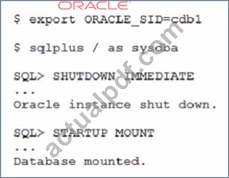
Which two are true?
- A. PDB$SEED is in read only state.
- B. Redo logs are opened.
- C. CDB$ROOT is in mount state.
- D. PDB1 and PDB2 are in mount state.
- E. PDB1 and PDB2 are in read only state.
Answer: B,E
NEW QUESTION # 46
RMAN is connected to a target database instance and an auxilary instance. You execute 3625the command: RMAN> DUPLICATE TARGET DATABASE TO dupdb FROM ACTIVE DATABASE SECTION SIZE 1G; What is the outcome?
- A. RMAN uses the pull method to restore files using image copies
- B. RMAN uses the pull method to restore files using backup sets
- C. RMAN uses the push method to transfer image copies
- D. RMAN uses the push method to transfer backup sets
Answer: B
NEW QUESTION # 47
Examine this configuration: 1. The ORCL database data files are in Automatic Storage Management (Oracle ASM) disk group +DATA. 2. ORCL uses disk group +FRA for the Fast Recovery Area. 3. LISTENER is the listener for ORCL. 4. The database, listener, ASM instance, and ASM disk groups are managed by Oracle Restart. 5. All components are currently shut down. You execute this command:
What is the outcome?
- A. Only the ORCL database instance and the +DATA and +FRA disk groups are started.
- B. Only the ORCL database instance is started.
- C. Only the ORCL database instance, the Oracle ASM instance, and the +DATA and +FRA disk groups are started.
- D. Only the ORCL database and the ASM instances are started.
- E. The ORCL database, the Oracle ASM instances, the +DATA and +FRA disk groups, and the LISTENER are started.
Answer: E
NEW QUESTION # 48
......
Oracle 1Z0-083 exam is designed to test the candidate's knowledge and skills in a variety of areas related to database administration. These include database security, backup and recovery, performance tuning, and database maintenance. 1Z0-083 exam also covers advanced topics such as high availability, data replication, and database upgrades.
Oracle 1Z0-083 certification exam is an advanced certification that validates the skills required to manage and maintain Oracle databases. It is highly valued in the industry and can open up new career opportunities. Candidates who pass the exam will receive the Oracle Database Administration II certification, which is a prerequisite for many advanced Oracle certifications.
Free 1Z0-083 Exam Dumps to Improve Exam Score: https://dumpstorrent.actualpdf.com/1Z0-083-real-questions.html
