

NCP-CN Tested & Approved Nutanix Certified Professional (NCP) Study Materials
Validate your Skills with Updated Nutanix Certified Professional (NCP) Exam Questions & Answers and Test Engine
Nutanix NCP-CN Exam Syllabus Topics:
| Topic | Details |
|---|---|
| Topic 1 |
|
| Topic 2 |
|
| Topic 3 |
|
| Topic 4 |
|
NEW QUESTION # 58
A Platform Engineer is deploying a new Kubernetes application in Amazon Web Services (AWS) Elastic Container Service for Kubernetes (EKS) and Azure Kubernetes Service (AKS). The engineer's team has decided to use a custom image instead of the default images provided by AWS or Azure for their clusters.
What functionality will the engineer lose in both AWS EKS and Azure AKS by choosing to use a custom image?
- A. Cluster networking and load balancing
- B. Native monitoring tools, logging, and alerting
- C. Ability to use GPUs and persistent storage
- D. Built-in autoscaling and security capabilities
Answer: D
Explanation:
Comprehensive and Detailed Explanation From General Kubernetes Knowledge:
Since this question involves AWS EKS and Azure AKS specifics outside the NKP context, and web search is unavailable, I will rely on general Kubernetes knowledge as of my last update. Using a custom image for EKS and AKS worker nodes means replacing the default, optimized images provided by AWS and Azure, which are pre-configured with components tailored for their managed Kubernetes services.
The primary functionality lost by using a custom image in both EKS and AKS is built-in autoscaling and security capabilities (Option C):
* Autoscaling: Both EKS and AKS rely on their default node images to integrate with their native autoscaling mechanisms, such as the EKS Cluster Autoscaler (which uses AWS Auto Scaling Groups) and AKS Cluster Autoscaler (which integrates with Azure Virtual Machine Scale Sets). Custom images may lack the necessary agents or configurations (e.g., AWS SSM Agent, Azure VM extensions) to communicate with these autoscaling services, requiring manual configuration.
* Security Capabilities: Default images include pre-configured security features, such as AWS's integration with IAM roles for service accounts (IRSA) and Azure's integration with Azure Active Directory (AAD) for RBAC. Custom images may not include these integrations, potentially breaking security features like automatic credential rotation or managed identity support unless manually configured.
Incorrect Options:
* A. Native monitoring tools, logging, and alerting: Monitoring and logging (e.g., AWS CloudWatch, Azure Monitor) are managed at the control plane level, not the node image level, so these features are generally unaffected by custom images.
* B. Cluster networking and load balancing: Networking (e.g., AWS VPC CNI, Azure CNI) and load balancing (e.g., AWS ALB, Azure Load Balancer) are configured by the control plane and CNI plugins, not the node image.
* D. Ability to use GPUs and persistent storage: GPU support and persistent storage (e.g., EBS, Azure Disk) depend on drivers and CSI plugins, which can be installed on custom images without losing functionality.
:
General Kubernetes Knowledge on EKS and AKS Image Customization.
AWS EKS Documentation (Conceptual): https://docs.aws.amazon.com/eks
Azure AKS Documentation (Conceptual): https://docs.microsoft.com/en-us/azure/aks
NEW QUESTION # 59
Prior to implementing NKP, a company had created a number of Kubernetes (K8s) clusters using kubeadm. While they are deploying new managed clusters via NKP, the company does not wish to migrate workloads from these pre-existing native K8s clusters over to new NKP clusters just yet.
What are the requirements to have these clusters attached to their NKP management cluster?
- A. An NKP management cluster admin account must be established on the K8s clusters.
- B. The version of the K8s clusters must be within N - 1 of the Kubernetes version of the NKP management cluster.
- C. The version of the K8s clusters must match the Kubernetes version of the NKP management cluster.
- D. The NKP management cluster must be able to reach the services and api-server of the target cluster.
Answer: D
NEW QUESTION # 60
What is a prerequisite for upgrading an NKP license to Ultimate?
- A. Size the Control Plane nodes appropriately to support the installation of default platform services.
- B. Size the ETCD nodes appropriately to support the installation of default platform services.
- C. Size the Sidecar containers appropriately to support the installation of default platform services.
- D. Size the Worker nodes appropriately to support the installation of default platform services.
Answer: A
NEW QUESTION # 61
An organization is setting up a new set of NKP clusters for R&D. The R&D director requires full admin access for the team on infrastructure dedicated to R&D.
What is the proper method for the engineer to ensure these objectives are met?
- A. Create an 'R&D' NKP workspace and project within this workspace
Create an NKP infrastructure provider in the 'R&D' NKP project
Create an 'R&D' NKP group for the R&D team members and assign admin-level roles within this project Deploy the NKP clusters into the 'R&D' workspace - B. Create an 'R&D' NKP connector and infrastructure provider
Create an 'R&D' NKP group and assign it admin-level roles
Assign the 'R&D' NKP group to the 'R&D' NKP connector
Deploy the NKP clusters into the 'R&D' workspace - C. Create an 'R&D' NKP connector and infrastructure provider
Create an 'R&D' NKP group and assign it admin-level roles
Assign the 'R&D' NKP group to the 'R&D' NKP infrastructure provider
Deploy the NKP clusters into the 'R&D' workspace - D. Create an 'R&D' NKP workspace
Create an 'R&D' infrastructure provider in this workspace
Create an 'R&D' NKP group for the R&D team members and assign admin-level roles within Deploy the NKP clusters into the 'R&D' workspace
Answer: D
Explanation:
The NKPA 6.10 documentation and Nutanix Best Practices recommend using workspaces to segment cluster deployments and their associated infrastructure providers, as well as to manage access control through RBAC.
The typical workflow is:
* Create an NKP workspace dedicated to the R&D environment.
* Create an infrastructure provider (e.g., vSphere, AHV) scoped to that workspace.
* Create an NKP group for the R&D team and assign admin roles to this group within the workspace.
* Deploy workload clusters in this workspace, leveraging the scoped infrastructure provider.
This ensures that:
* The R&D team has full administrative control over their resources.
* Clusters and infrastructure are logically isolated in the R&D workspace.
* RBAC policies are applied cleanly within the workspace context.
Reference:
Nutanix Kubernetes Platform Administration (NKPA) 6.10 - "Workspaces and RBAC" NCP-CN 6.10 Study Guide - "Workspace and Cluster Management Best Practices"
NEW QUESTION # 62
Which NKP-supported infrastructure will not receive CAPI components when an NKP cluster is deployed to it?
- A. vSphere
- B. GCP
- C. AKS
- D. Nutanix
Answer: C
NEW QUESTION # 63
A company recently deployed NKP. A Platform Engineer was asked to attach the existing Amazon EKS. A workspace and project were created accordingly, and resource requirements were met. What does the engineer need to do first to prepare the EKS clusters?
- A. Configure HAProxy to get connected to EKS clusters.
- B. Create a service account with cluster-admin permissions.
- C. Configure a ConfigMap according to EKS configuration.
- D. Deploy cert-manager in the EKS clusters.
Answer: B
NEW QUESTION # 64
A Platform Engineer is deploying NKP into a highly secure vSphere environment. The NKP cluster will be air-gapped, and must also be FIPS compliant. The OS platform to be used for NKP cluster nodes is RHEL.
What must the engineer do to properly prep an OS image and have it be deployed as a FIPS compliant NKP cluster node?
- A. Verify the OS itself has been placed in fips mode.
When performing the NKP image build operation, be sure to include the offline fips and fips overrides.
When performing the NKP cluster deploy operation, be sure to include the FIPS version references for kubernetes, kubectl and etcd. - B. Verify the OS itself has been placed in fips mode.
When performing the NKP image build operation, be sure to include the offline fips and fips overrides.
When performing the NKP cluster deploy operation, be sure to include the FIPS version references for kubernetes and etcd. - C. Verify the OS itself has been placed in fips mode.
When performing the NKP cluster deploy operation, be sure to include the FIPS version references for kubernetes, kubectl and etcd. - D. Verify the OS itself has been placed in fips mode.
When performing the NKP image build operation, be sure to include the offline fips override.
When performing the NKP cluster deploy operation, be sure to include the FIPS version references for kubernetes and etcd.
Answer: B
Explanation:
To create a FIPS-compliant NKP deployment in an air-gapped environment, the following must be done:
* Verify the OS (RHEL) itself is in FIPS mode.
* When building the image, include both the offline fips and fips overrides to ensure the image and components are built in compliance.
* When deploying the cluster, include FIPS-specific references for both Kubernetes and etcd components.
Exact extract:
"For FIPS deployments, ensure the OS is in FIPS mode, and include both offline fips and fips overrides during image creation to ensure compliant images and deployment." Reference:
Nutanix Kubernetes Platform Administration (NKPA) 6.10 - "Deploying NKP in FIPS Environments" NCP-CN 6.10 Study Guide - "FIPS Compliance Best Practices"
=======
NEW QUESTION # 65
To keep an NKP cluster and applications healthy and drive productivity forward, a Platform Engineer needs to stay informed of all events occurring within the cluster. What component of kube-prometheus-stack will help the engineer to stay informed of these events in NKP?
- A. alertmanager
- B. node-exporter
- C. prometheus-operator
- D. service monitors
Answer: A
Explanation:
The kube-prometheus-stack is a key component of NKP's monitoring stack, providing tools for metrics collection, visualization, and alerting. The NKPA course explains that Alertmanager, a component of the kube-prometheus-stack, is responsible for handling alerts generated from Prometheus metrics. It aggregates, deduplicates, and routes notifications to the appropriate channels (e.g., email, Slack, PagerDuty), ensuring that the Platform Engineer stays informed of critical events and anomalies in the NKP cluster, such as node failures, resource exhaustion, or application errors.
The Nutanix Cloud Native (NCP-CN) 6.10 Study Guide states: "Alertmanager in the kube-prometheus-stack processes alerts from Prometheus, enabling administrators to stay informed of cluster events through configured notification channels." By configuring Alertmanager with appropriate routing rules and receivers, the engineer can receive real-time notifications about cluster events, driving proactive management and productivity.
Incorrect Options:
* A. prometheus-operator: The operator manages Prometheus and related resources but does not directly handle event notifications.
* B. service monitors: Service monitors define how Prometheus scrapes metrics, not how events are communicated.
* D. node-exporter: Node-exporter collects node-level metrics, not event notifications.
:
Nutanix Kubernetes Platform Administration (NKPA) Course, Section on Monitoring and Alerting.
Nutanix Cloud Native (NCP-CN) 6.10 Study Guide, Chapter on Day 2 Operations.
Nutanix Cloud Bible, NutanixKubernetesPlatform Section: https://www.nutanixbible.com Prometheus Documentation: https://prometheus.io/docs/alerting/alertmanager
NEW QUESTION # 66
A company has enabled auto-scaling within an NKP cluster. What is the behavior for auto-scaling?
- A. Nodes will be CAPI-created or CAPI-deleted as needed by the cluster.
- B. The Power-On Status/Mode of a node is changed to meet load conditions.
- C. Memory is hot-added or hot-removed from a node.
- D. CPU is hot-added or hot-removed from a node.
Answer: A
Explanation:
The NKPA course explains that NKP supports auto-scaling for clusters using Cluster API (CAPI), which manages the lifecycle of Kubernetes nodes. When auto-scaling is enabled, NKP monitors cluster workloads and automatically adjusts the number of nodes based on demand. The behavior involves CAPI creating or deleting nodes as needed to scale the cluster up or down, ensuring optimal resource utilization.
The Nutanix Cloud Native (NCP-CN) 6.10 Study Guide states: "NKP auto-scaling uses Cluster API to dynamically create or delete nodes in response to workload demands, ensuring the cluster scales efficiently." For example, if the workload increases, CAPI provisions additional worker nodes; if demand decreases, CAPI deletes nodes to reduce costs.
Incorrect Options:
* A. CPU is hot-added or hot-removed: Hot-adding/removing CPU is not a Kubernetes auto-scaling behavior; scaling involves adding/removing nodes.
* B. Memory is hot-added or hot-removed: Similar to CPU, memory scaling at the node level is not supported in this context.
* C. Power-On Status/Mode of a node is changed: Auto-scaling does not involve changing node power states; it adds or removes nodes.
:
Nutanix Kubernetes Platform Administration (NKPA) Course, Section on Auto-Scaling.
Nutanix Cloud Native (NCP-CN) 6.10 Study Guide, Chapter on Day 2 Operations.
Nutanix Cloud Bible, NutanixKubernetesPlatform Section: https://www.nutanixbible.com Cluster API Documentation: https://cluster-api.sigs.k8s.io
NEW QUESTION # 67
A Cloud Engineer wishes to attach existing AKS clusters to a newly deployed NKP management cluster.
What should the engineer consider specific to attaching these types of clusters to NKP?
- A. Cert-manager, which is included in NKP, is deployed by default on AKS clusters.
- B. A separate service account should be created for them because their kubeconfig files are not usable out- of-box by NKP Kommander.
- C. AKS does not have the kubelet installed on them. Therefore the KIB-prep process should be performed on each of the nodes in the AKS clusters prior to attaching them.
- D. AKS nodes do not use containerd as its container runtime. Therefore it should be deployed to each of the nodes in the AKS clusters prior to attaching them.
Answer: B
Explanation:
The NKPA 6.10 documentation specifies that when attaching external clusters like AKS (Azure Kubernetes Service) to an NKP management cluster using Kommander, the default kubeconfig provided by AKS is typically not directly usable because it lacks the necessary service account details and permissions for NKP to properly manage the cluster. Therefore, the recommended and required approach is to create a separate service account in AKS with the necessary permissions and generate a kubeconfig file for this service account.
Key reference:
"When importing external clusters, such as AKS, the default kubeconfig might not contain the correct permissions for NKP Kommander. A custom kubeconfig for a service account with cluster-admin privileges should be created and used to attach the cluster to NKP." Reference:
Nutanix Kubernetes Platform Administration (NKPA) 6.10 - "Attaching External Clusters" NCP-CN 6.10 Study Guide - "Managing External Clusters"
=======
NEW QUESTION # 68
An infrastructure team has configured a Backup Storage Location on an existing AWS bucket and created a backup named testbackup. What command can the team use to view the backup?
- A. kubectl get backupstoragelocations -n ${WORKSPACE_NAMESPACE} -o yaml
- B. kubectl get backupstoragelocations -n ${testbackup} -o yaml
- C. velero backup describe testbackup
- D. velero backup describe aws-velero-testbackup
Answer: C
Explanation:
The Nutanix Kubernetes Platform (NKP) integrates Velero, an open-source tool, for backup and restore operations as part of its Day 2 operations. The NKPA course explains that after configuring a Backup Storage Location (e.g., an AWS S3 bucket) and creating a backup, administrators can view details of the backup using the Velero CLI. The correct command to view the details of a backup named testbackup is velero backup describe testbackup. This command provides a detailed description of the backup, including its status, resources included, and storage location.
The Nutanix Cloud Native (NCP-CN) 6.10 Study Guide states: "To inspect a Velero backup in NKP, use the velero backup describe <backup-name> command to display detailed information about the backup, such as its creation time, expiration, and included resources." The backup name (testbackup) is specified as created by the team, and no prefix like aws-velero- is indicated in the question, making option C the correct choice.
Incorrect Options:
* A. kubectl get backupstoragelocations -n ${testbackup} -o yaml: This command retrieves Backup Storage Location objects, not backup details. The namespace ${testbackup} is also incorrect, as Velero resources are typically in a specific namespace (e.g., velero).
* B. velero backup describe aws-velero-testbackup: The backup name is testbackup, not aws-velero- testbackup. The NKPA course does not indicate any prefix for the backup name.
* D. kubectl get backupstoragelocations -n ${WORKSPACE_NAMESPACE} -o yaml: This retrieves Backup Storage Locations, not the backup itself, and does not provide backup details.
:
Nutanix Kubernetes Platform Administration (NKPA) Course, Section on Backup and Restore with Velero.
Nutanix Cloud Native (NCP-CN) 6.10 Study Guide, Chapter on Day 2 Operations.
Nutanix Cloud Bible, NutanixKubernetesPlatform Section: https://www.nutanixbible.com Velero Documentation: https://velero.io
NEW QUESTION # 69
A Platform Engineer manages an NKP environment and is preparing a machine image to become an NKP cluster node. Which statement is correct regarding the default node preparation process?
- A. Ansible is used to make the OS image CAPI-compliant for use as an NKP node.
- B. Terraform is utilized to clone an existing OS image for use as an NKP node.
- C. Goss is used to harden the OS image for use as an NKP node.
- D. Packer is used to make the OS image CAPI-compliant for use as an NKP node.
Answer: D
Explanation:
The NKPA course details the default node preparation process for NKP cluster nodes, which involves creating a machine image that is compliant with Cluster API (CAPI) standards. The primary tool used in this process is Packer, which automates the creation of machine images by provisioning a base OS image (e.g., Ubuntu or Rocky Linux) with the necessary components for Kubernetes, such as kubeadm, containerd, and other dependencies.
Packer ensures the image is CAPI-compliant by installing the required Kubernetes binaries, configuring the container runtime, and setting up networking and storage components. The Nutanix Cloud Native (NCP-CN)
6.10 Study Guide states: "In the default node preparation process for NKP, Packer is used to build a CAPI- compliant OS image, installing Kubernetes components and dependencies for use as an NKP node." This process is typically orchestrated by NKP Image Builder (NIB) or Kubernetes Image Builder (KIB), both of which rely on Packer for image creation.
Incorrect Options:
* B. Ansible is used to make the OS image CAPI-compliant: Ansible is used by KIB/NIB to apply configurations during the Packer build process, but Packer is the primary tool for creating the image.
Ansible alone does not make the image CAPI-compliant.
* C. Goss is used to harden the OS image: Goss is a validation tool that can be used for image hardening, but it is not part of the default NKP node preparation process. Hardening is an optional step.
* D. Terraform is utilized to clone an existing OS image: Terraform is for infrastructure provisioning, not image creation or cloning. Packer handles image creation in NKP.
:
Nutanix Kubernetes Platform Administration (NKPA) Course, Section on Node Preparation.
Nutanix Cloud Native (NCP-CN) 6.10 Study Guide, Chapter on NKP Deployment Prerequisites.
Nutanix Cloud Bible, NutanixKubernetesPlatform Section: https://www.nutanixbible.com Packer Documentation: https://www.packer.io
NEW QUESTION # 70
Which NKP-supported infrastructure will not receive CAPI components when an NKP cluster is deployed to it?
- A. vSphere
- B. GCP
- C. AKS
- D. Nutanix
Answer: C
Explanation:
NKP uses Cluster API (CAPI) to provision and manage Kubernetes clusters across supported infrastructures, including Nutanix AHV, vSphere, AWS, and GCP. CAPI components, such as controllers and providers, are deployed to manage the lifecycle of clusters on these platforms. However, when NKP attaches to a managed Kubernetes service like Azure Kubernetes Service (AKS), CAPI components are not deployed because AKS is managed by Azure, and NKP only integrates with the cluster for fleet management, not provisioning.
The NKPA course explains: "For managed Kubernetes services like AKS, NKP attaches the cluster to its management plane without deploying CAPI components, as the underlying infrastructure is managed by the cloud provider." The Nutanix Cloud Native (NCP-CN) 6.10 Study Guide reinforces this: "CAPI is used for NKP-managed clusters on Nutanix, vSphere, AWS, and GCP, but not for attached managed services like AKS." Incorrect Options:
* A. vSphere: NKP deploys CAPI components (e.g., CAPV provider) to manage vSphere-based clusters.
* B. GCP: NKP deploys CAPI components (e.g., CAPG provider) for GCP-based clusters.
* C. Nutanix: NKP deploys CAPI components (e.g., CAPA provider for AHV) for Nutanix AHV clusters.
:
Nutanix Kubernetes Platform Administration (NKPA) Course, Section on Infrastructure Support.
Nutanix Cloud Native (NCP-CN) 6.10 Study Guide, Chapter on CAPI Integration.
Nutanix Cloud Bible, NutanixKubernetesPlatform Section: https://www.nutanixbible.com
NEW QUESTION # 71
A Platform Engineer is deploying an NKP cluster within an air-gapped AWS environment. However, after an infrastructure planning session with the network team, it's been determined that the default CIDR block range that is used by pods on NKP clusters is already in use in their environment.
How can the engineer ensure there are no collisions between NKP pod traffic and the existing network using that subnet range?
- A. Because the environment is air-gapped, there will be no network traffic collision concerns and no adjustment needs to be made to the pod network CIDR block range.
- B. Create an NKP infrastructure provider for AWS in the NKP UI.Select the Advanced Options button from the Network section of the Create Cluster page and specify a unique CIDR block range within the pod network field.
- C. Create the NKP cluster's manifest using the nkp create cluster command set and include the pod CIDR block range parameter when generating the cluster manifest.Deploy the NKP cluster manifest.
- D. Create an NKP infrastructure provider for AWS in the NKP UI.When deploying the NKP cluster through the UI, specify a unique CIDR block range for the pod network field in the Network section of the Create Cluster page.
Answer: C
NEW QUESTION # 72 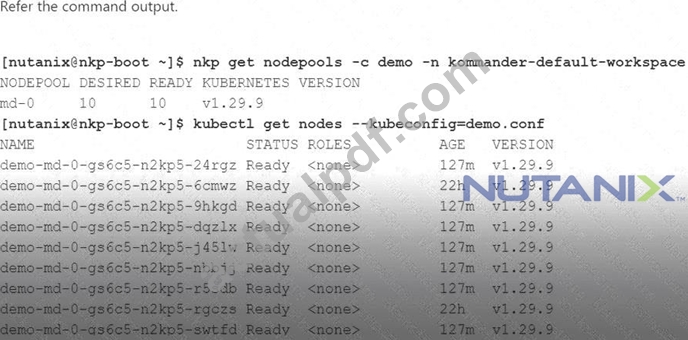
The Platform Engineer needs to expand an NKP Pro demo cluster due to workload capacity constraints. The demo cluster has 150 vCPUs available to it from a licensing standpoint. Each worker node has 8 vCPUs and each control plane node has 4 vCPUs.
Which two options are valid for expanding the demo cluster and remaining compliant with licensing? (Choose two.)
- A. Create a new worker nodepool consisting of 10 nodes with 8 vCPUs per node.
- B. Expand the original worker nodepool by up to 4 nodes and create a new worker nodepool consisting of
6 nodes with 4 vCPUs/node. - C. Add 6 additional control planes.
- D. Expand the original worker nodepool by up to 8 nodes.
Answer: B,D
Explanation:
According to the NKPA 6.10 documentation, licensing in an NKP cluster is constrained by the total number of vCPUs assigned to all nodes (workers and control planes). In this scenario, the cluster has a maximum of
150 vCPUs available.
The existing output shows 10 worker nodes, each with 8 vCPUs (10×8=80 vCPUs) and 3 control plane nodes, each with 4 vCPUs (3×4=12 vCPUs).
* Current vCPU usage: 80 + 12 = 92 vCPUs.
* Remaining vCPUs: 150 - 92 = 58 vCPUs.
Option A:
Adding 6 control plane nodes (6×4=24 vCPUs).
This would increase control planes to 9 total (3 existing + 6 new). Control plane nodes would consume
9×4=36 vCPUs.
Worker nodes remain at 80 vCPUs.
Total vCPU usage: 36 + 80 = 116 vCPUs (still under 150 vCPUs).
However, it's unusual and unnecessary to have 9 control planes in a typical NKP setup. NKPA and NCP-CN best practices indicate typically no more than 3 or 5 control planes for HA. Therefore, this is technically possible but not recommended or standard practice. So not selected.
Option B:
Expanding the existing worker nodepool by 8 nodes (8×8=64 vCPUs).
This would add 64 vCPUs to the current 92 vCPUs:
92 + 64 = 156 vCPUs # exceeds licensing limit.
Correction: The question specifies "expand up to 8 nodes," so it's possible to expand by only 7 nodes (7×8=56 vCPUs).
92 + 56 = 148 vCPUs # within licensing limits.
Thus, expanding by up to 7 nodes is valid.
Option C:
Creating a new worker nodepool with 10 nodes (10×8=80 vCPUs).
This would add 80 vCPUs to the existing 92 vCPUs:
92 + 80 = 172 vCPUs # exceeds 150 vCPU licensing limit.
Not valid.
Option D:
Expanding the original worker nodepool by up to 4 nodes (4×8=32 vCPUs) = +32 vCPUs.
Adding a new nodepool of 6 nodes with 4 vCPUs/node (6×4=24 vCPUs) = +24 vCPUs.
Total increase: 32 + 24 = 56 vCPUs.
Total vCPU usage: 92 + 56 = 148 vCPUs # within the 150 vCPU limit.
Thus, valid.
Extract Reference:
* NKPA 6.10 - "Cluster Sizing and Licensing"
* Nutanix Kubernetes Platform Administration (NKPA) - Licensing Considerations
"The total number of vCPUs for all nodes (control planes and workers) must not exceed the licensed vCPU capacity of the NKP deployment." This confirms that Options B and D are the two valid approaches to expand the cluster while remaining compliant with licensing constraints.
NEW QUESTION # 73
A developer asked a Platform Engineer to review a deployment in the cluster called iot-1 in the workspace iot-plant-3, but the engineer does not have the kubeconfig file. Which command is valid for generating the kubeconfig file to review the Kubernetes cluster?
- A. kubectl get kubeconfig --cluster-name=iot-1 -w iot-plant-3 > iot-1.conf
- B. nkp get kubeconfig -c iot-1 -w iot-plant-3 > iot-1.conf
- C. kubectl get secret iot-1 -n kommander > iot-1.conf
- D. nkp get configmaps -n iot-plant-3 -c iot-1 > iot-1.conf
Answer: B
NEW QUESTION # 74
A Platform Engineer is going to deploy NKP to a Nutanix cluster on-prem as well as Amazon EKS. What is the function of the bootstrap cluster for this architecture?
- A. Simplifies the networking requirements for Kubernetes.
- B. Uses Cluster API for infrastructure-agnostic provisioning.
- C. Saves cost by minimizing resources required for provisioning.
- D. Increases security from a single point of entry.
Answer: B
Explanation:
The NKPA course explains the role of a bootstrap cluster in NKP deployments, particularly in hybrid architectures involving Nutanix on-prem and Amazon EKS. A bootstrap cluster is a temporary Kubernetes cluster created during the deployment process to initialize Cluster API (CAPI) components, which manage the lifecycle of the target NKP clusters. The primary function of the bootstrap cluster is to use Cluster API for infrastructure-agnostic provisioning (Option D).
CAPI enables NKP to provision clusters across different infrastructures (e.g., Nutanix AHV, AWS EKS) in a consistent, infrastructure-agnostic manner. The bootstrap cluster runs the CAPI controllers (e.g., CAPX for Nutanix, CAPA for AWS) that orchestrate the creation of the target clusters, abstracting the underlying infrastructure details. The Nutanix Cloud Native (NCP-CN) 6.10 Study Guide states: "The bootstrap cluster in NKP uses Cluster API to provide infrastructure-agnostic provisioning, enabling consistent cluster creation across diverse environments like Nutanix AHV and Amazon EKS." This ensures that the same CAPI-based workflow can deploy clusters on both on-prem Nutanix and cloud-based EKS.
Incorrect Options:
* A. Increases security from a single point of entry: A bastion host, not a bootstrap cluster, provides a single point of entry for security. The bootstrap cluster is temporary and focuses on provisioning.
* B. Simplifies the networking requirements for Kubernetes: Networking is managed by the target cluster's CNI (e.g., Calico), not the bootstrap cluster.
* C. Saves cost by minimizing resources required for provisioning: The bootstrap cluster is temporary and does not significantly impact costs; its purpose is provisioning, not cost-saving.
:
Nutanix Kubernetes Platform Administration (NKPA) Course, Section on Bootstrap Cluster Functionality.
Nutanix Cloud Native (NCP-CN) 6.10 Study Guide, Chapter on Building NKP Clusters.
Nutanix Cloud Bible, NutanixKubernetesPlatform Section: https://www.nutanixbible.com Cluster API Documentation: https://cluster-api.sigs.k8s.io
NEW QUESTION # 75
There is a private registry for the NKP deployment and the company has an NKP Ultimate license. A Platform Engineer is using the Podman tool and is already logged in. Now, the engineer needs to send the private registry with the NKP Catalog Applications.
What command should the engineer use?
- A. podman load -i ./container-images/nkp/catalog-applications-image-bundle-v2.12.0.tar
- B. docker load -i ./container-images/nkp/catalog-applications-image-bundle-v2.12.0.tar
- C. nkp push bundle --bundle ./container-images/nkp/catalog-applications-image-bundle-v2.12.0.tar --to- registry=${REGISTRY_URL} --to-registry-username=${REGISTRY_USERNAME} --to-registry- password=${REGISTRY_PASSWORD}
- D. nkp apply bundle -f ./container-images/nkp/catalog-applications-image-bundle-v2.12.0.tar --to- registry=${REGISTRY_URL} --to-registry-username=${REGISTRY_USERNAME} --to-registry- password=${REGISTRY_PASSWORD}
Answer: C
Explanation:
To push the NKP Catalog Applications image bundle to a private registry, the official nkp push bundle command must be used with the specified parameters to authenticate and push the bundle to the registry.
Exact extract:
"Use the nkp push bundle command to upload the NKP catalog applications image bundle to the specified private registry, ensuring secure and complete image upload." Reference:
Nutanix Kubernetes Platform Administration (NKPA) 6.10 - "Pushing Catalog Applications to Private Registries" NCP-CN 6.10 Study Guide - "Private Registry Integration for NKP"
NEW QUESTION # 76
A company is developing a new web application consisting of several microservices, including:
Authentication service
User management service
Payment processing service Each microservice is developed by different teams and requires an isolated environment for testing and development. To facilitate development and testing, the team decides to create a specific workspace in NKP. What should the team do to start this new creation?
- A. From the Administration selection dropdown list in Infrastructure Providers, select Add Infrastructure Provider.
- B. From the workspace selection dropdown list in the top menu bar, select Add Workspace.
- C. From the workspace selection dropdown list in the top menu bar, select Create Workspace.
- D. From the Cluster selection, select Add Cluster.
Answer: C
NEW QUESTION # 77
Refer to the exhibits.
A Cloud Administrator had provisioned a Kubernetes cluster named demo that is no longer actively being used. A Quick review from the Systems Engineer confirms that the following VMs are part of the demo Kubernetes cluster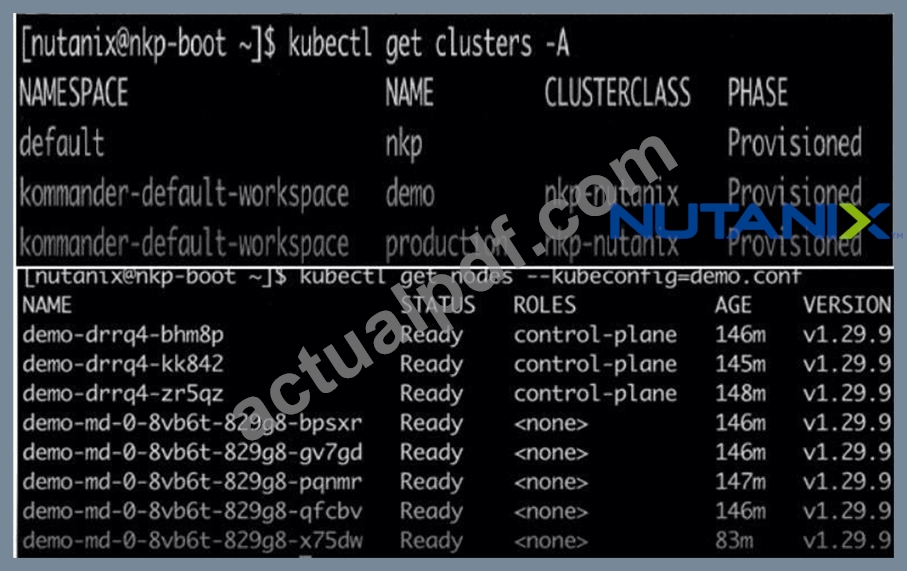
How should the demo cluster be properly deleted?
- A. Delete all the VMs and inform of the results.
- B. Run kubectl config delete-cluster demo -n kommander-default-workspace and delete the VMs.
- C. Run nkp delete cluster -c demo -n kommander-default-workspace
- D. Run acli vm.delete demo* from a CVM.
Answer: C
Explanation:
Comprehensive and Detailed Explanation:
The correct procedure for deleting an NKP cluster involves using the nkp delete cluster command with the appropriate cluster name and namespace. This ensures that not only the Kubernetes resources but also the corresponding NKP resources (e.g., nodepools, Kommander integration) are deleted cleanly and consistently.
Simply deleting the VMs does not clean up the associated NKP management objects. This approach is detailed in the NKP documentation for cluster lifecycle management, emphasizing the need to use the provided CLI commands for full removal.
References: NCP-CN-6.10 Course Material - Cluster Deletion Commands
NEW QUESTION # 78
An administrator has been trying to deploy an initial AHV-based NKP cluster in a dark site (no Internet connectivity) environment using the command shown in the question.
nkp create cluster nutanix \
--cluster-name=$CLUSTER_NAME \
--control-plane-prism-element-cluster=$PE_NAME \
--worker-prism-element-cluster=$PE_NAME \
--control-plane-subnets=$SUBNET_ASSOCIATED_WITH_PE \
--worker-subnets=$SUBNET_ASSOCIATED_WITH_PE \
--control-plane-endpoint-ip=$AVAILABLE_IP_FROM_SAME_SUBNET \
--csi-storage-container=$NAME_OF_YOUR_STORAGE_CONTAINER \
--endpoint=$PC_ENDPOINT_URL \
--control-plane-vm-image=$NAME_OF_OS_IMAGE_CREATED_BY_NKP_CLI \
--worker-vm-image=$NAME_OF_OS_IMAGE_CREATED_BY_NKP_CLI \
--registry-url=${REGISTRY_URL} \
--registry-mirror-username=${REGISTRY_USERNAME} \
--registry-mirror-password=${REGISTRY_PASSWORD} \
--kubernetes-service-load-balancer-ip-range $START_IP-$END_IP \
--self-managed
Which missing attribute needs to be added in order for the deployment?
- A. --registry-username
- B. --airgapped
- C. --insecure
- D. --registry-url
Answer: B
NEW QUESTION # 79
A Kubernetes administrator needs to deploy a new Kubernetes cluster into a new workspace. This cluster requires a predictive analytics solution that detects current and future anomalies. Which option does the administrator need to deploy after the cluster is ready?
- A. Nutanix Pulse
- B. NKP Insights
- C. NKP AI Navigator
- D. NCM Intelligent Ops
Answer: B
Explanation:
The NKPA course highlights that NKP Insights is the platform's integrated solution for observability and analytics, providing predictive analytics to detect current and future anomalies in Kubernetes clusters. NKP Insights leverages machine learning to analyze metrics, logs, and events, identifying performance issues and potential failures proactively. After deploying a new cluster, the administrator can enable NKP Insights as a platform application in the workspace to meet the predictive analytics requirement.
The Nutanix Cloud Native (NCP-CN) 6.10 Study Guide states: "NKP Insights provides predictive analytics and anomaly detection for Kubernetes clusters, enabling administrators to monitor and optimize cluster performance." This is deployed via the NKP UI or CLI by enabling the Insights application in the workspace.
Incorrect Options:
* B. NCM Intelligent Ops: Nutanix Cloud Manager (NCM) Intelligent Ops is for broader infrastructure management, not Kubernetes-specific analytics.
* C. Nutanix Pulse: Pulse is a telemetry service for Nutanix support, not for analytics.
* D. NKP AI Navigator: This is not a recognized NKP component in the NKPA documentation.
:
Nutanix Kubernetes Platform Administration (NKPA) Course, Section on Observability and Insights.
Nutanix Cloud Native (NCP-CN) 6.10 Study Guide, Chapter on Day 2 Operations.
Nutanix Cloud Bible, NutanixKubernetesPlatform Section: https://www.nutanixbible.com
NEW QUESTION # 80
After loading the NKP bundles to a private registry in an air-gapped environment, a Platform Engineer now needs the Konvoy bootstrap image to create the bootstrap cluster. The Konvoy image has not been loaded into the registry. Which is the most viable command to load the Konvoy bootstrap image on the bastion host?
- A. docker image tag konvoy-bootstrap-image-<version>.tar version docker.io/konvoy-bootstrap version
- B. nkp push bundle --bundle konvoy-bootstrap-image-<version>.tar --to-registry=<REGISTRY_URL>
- C. nkp load image -f konvoy-bootstrap-image-<version>.tar --to-registry=<REGISTRY_URL>
- D. docker load -i konvoy-bootstrap-image-<version>.tar
Answer: D
NEW QUESTION # 81
......
NCP-CN [Jun-2026] Newly Released] NCP-CN Exam Questions For You To Pass: https://dumpstorrent.actualpdf.com/NCP-CN-real-questions.html
