

Read Online DP-100 Test Practice Test Questions Exam Dumps
Easily To Pass New DP-100 Premium Exam Updated [Jun 21, 2026]
NEW QUESTION # 284
You create an Azure Data Lake Storage Gen2 stowage account named storage1 containing a file system named fsi and a folder named folder1.
The contents of folder1 must be accessible from jobs on compute targets in the Azure Machine Learning workspace.
You need to construct a URl to reference folder1.
How should you construct the URI? To answer, select the appropriate options in the answer area.
NOTE: Each correct selection is worth one point.
Answer:
Explanation:
NEW QUESTION # 285
You need to correct the model fit issue.
Which three actions should you perform in sequence? To answer, move the appropriate actions from the list of actions to the answer area and arrange them in the correct order.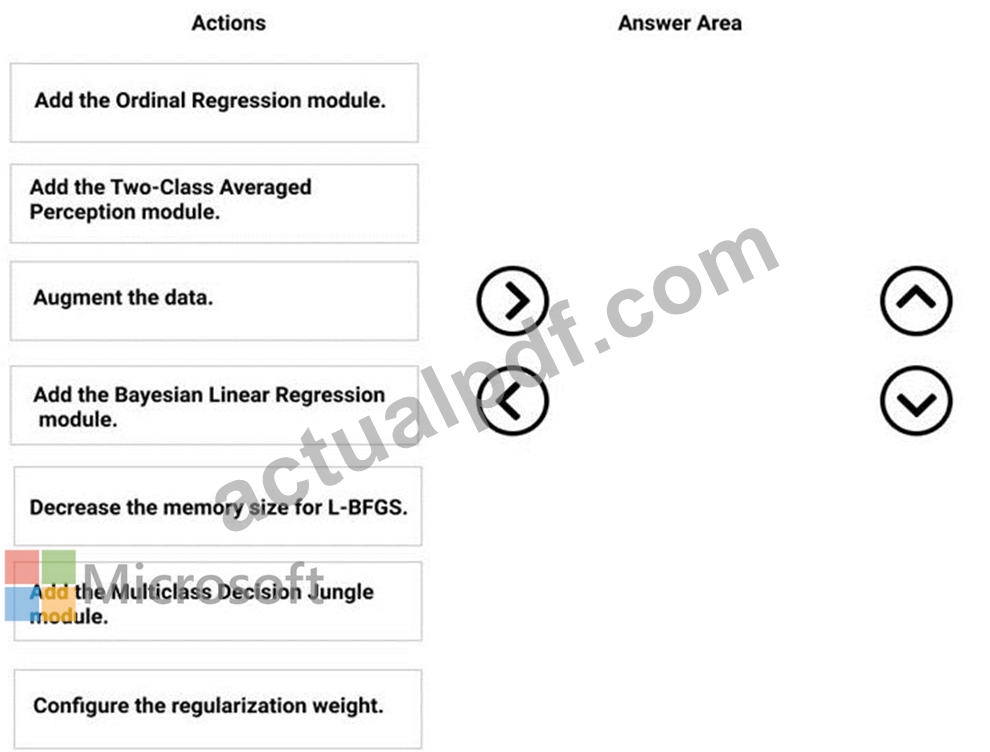
Answer:
Explanation: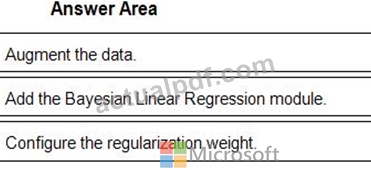
1 - Augment the data.
2 - Add the Bayesian Linear Regression module.
3 - Configure the regularization weight.
Reference:
https://docs.microsoft.com/en-us/azure/machine-learning/studio-module-reference/linear-regr ession
NEW QUESTION # 286
You have a model with a large difference between the training and validation error values.
You must create a new model and perform cross-validation.
You need to identify a parameter set for the new model using Azure Machine Learning Studio.
Which module you should use for each step? To answer, drag the appropriate modules to the correct steps. Each module may be used once or more than once, or not at all. You may need to drag the split bar between panes or scroll to view content.
NOTE: Each correct selection is worth one point.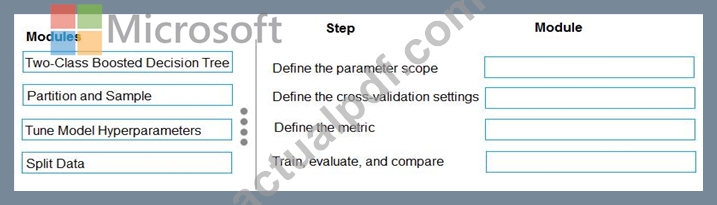
Answer:
Explanation: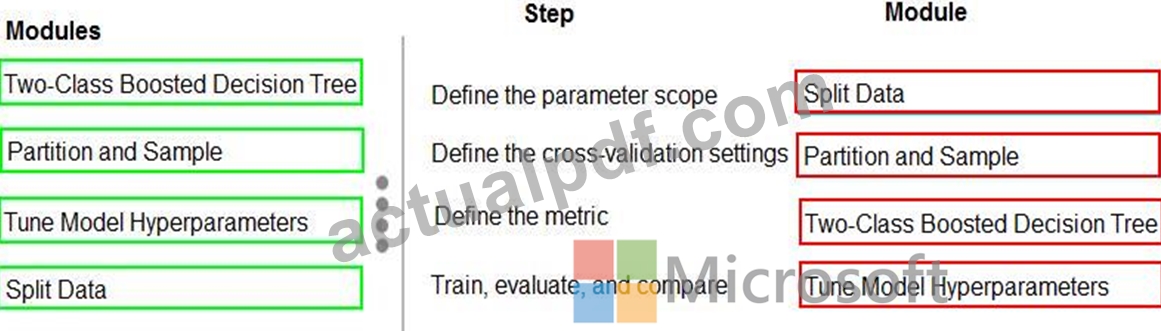
Explanation:
Box 1: Split data
Box 2: Partition and Sample
Box 3: Two-Class Boosted Decision Tree
Box 4: Tune Model Hyperparameters
Integrated train and tune: You configure a set of parameters to use, and then let the module iterate over multiple combinations, measuring accuracy until it finds a "best" model. With most learner modules, you can choose which parameters should be changed during the training process, and which should remain fixed.
We recommend that you use Cross-Validate Model to establish the goodness of the model given the specified parameters. Use Tune Model Hyperparameters to identify the optimal parameters.
References:
https://docs.microsoft.com/en-us/azure/machine-learning/studio-module-reference/partition-and-sample
NEW QUESTION # 287
You create an Azure Databricks workspace and a linked Azure Machine Learning workspace.
You have the following Python code segment in the Azure Machine Learning workspace:
import mlflow
import mlflow.azureml
import azureml.mlflow
import azureml.core
from azureml.core import Workspace
subscription_id = 'subscription_id'
resourse_group = 'resource_group_name'
workspace_name = 'workspace_name'
ws = Workspace.get(name=workspace_name,
subscription_id=subscription_id,
resource_group=resource_group)
experimentName = "/Users/{user_name}/{experiment_folder}/{experiment_name}" mlflow.set_experiment(experimentName) uri = ws.get_mlflow_tracking_uri() mlflow.set_tracking_uri(uri) Instructions: For each of the following statements, select Yes if the statement is true. Otherwise, select No.
NOTE: Each correct selection is worth one point.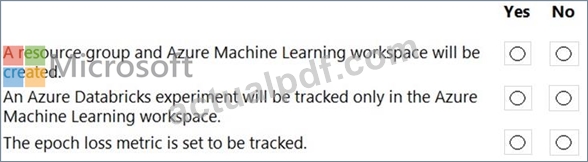
Answer:
Explanation: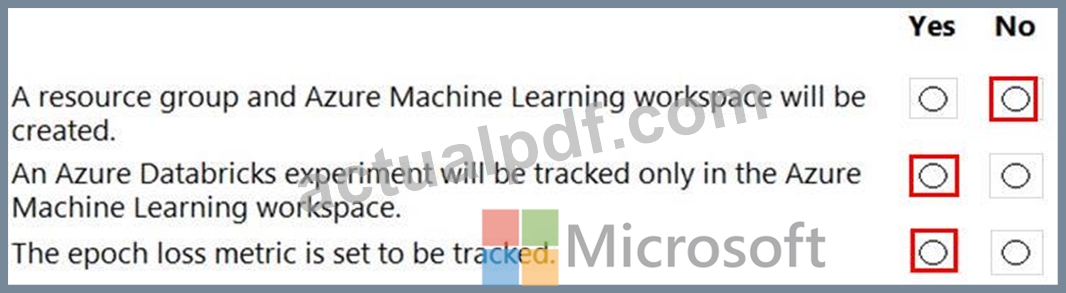
Reference:
https://docs.microsoft.com/en-us/python/api/azureml-core/azureml.core.workspace.workspace
https://docs.microsoft.com/en-us/azure/machine-learning/how-to-use-mlflow
NEW QUESTION # 288
You write code to retrieve an experiment that is run from your Azure Machine Learning workspace.
The run used the model interpretation support in Azure Machine Learning to generate and upload a model explanation.
Business managers in your organization want to see the importance of the features in the model.
You need to print out the model features and their relative importance in an output that looks similar to the following.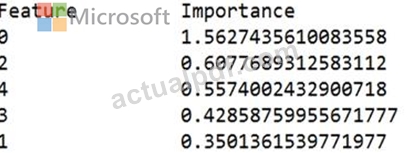
How should you complete the code? To answer, select the appropriate options in the answer area.
NOTE: Each correct selection is worth one point.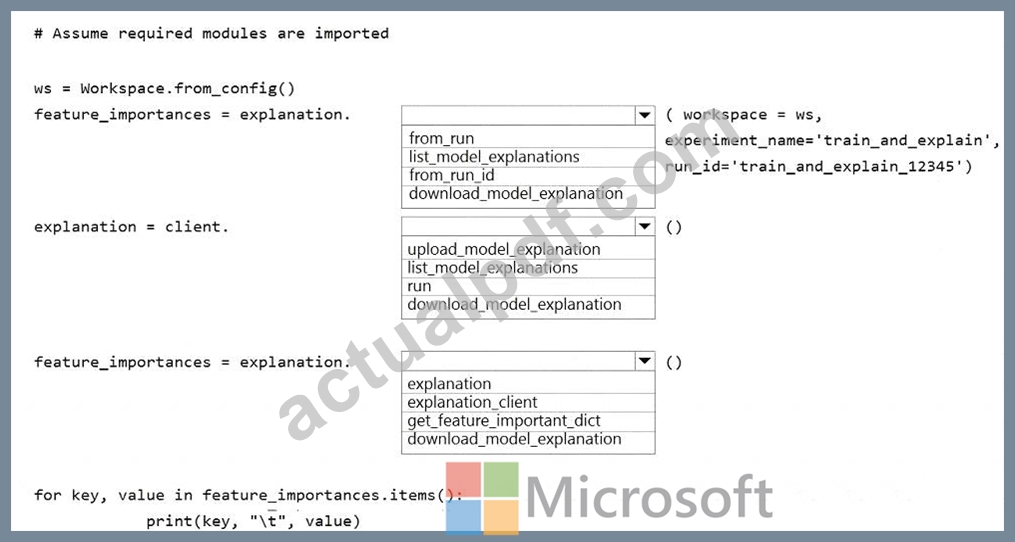
Answer:
Explanation: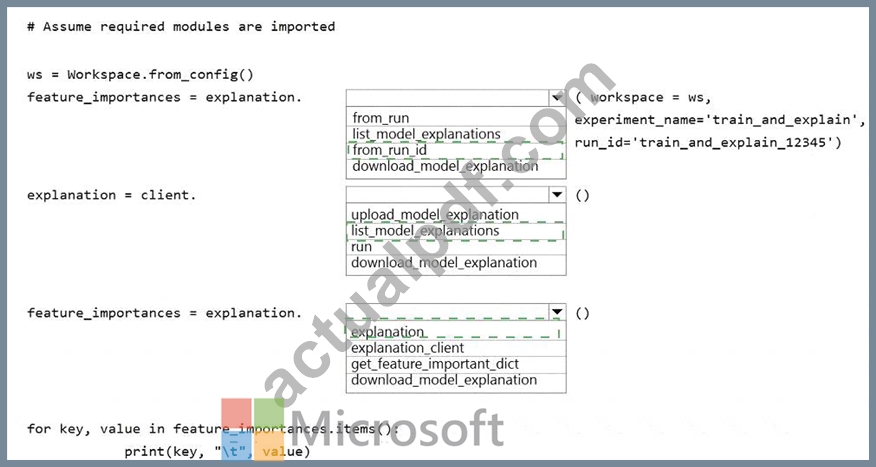
Explanation: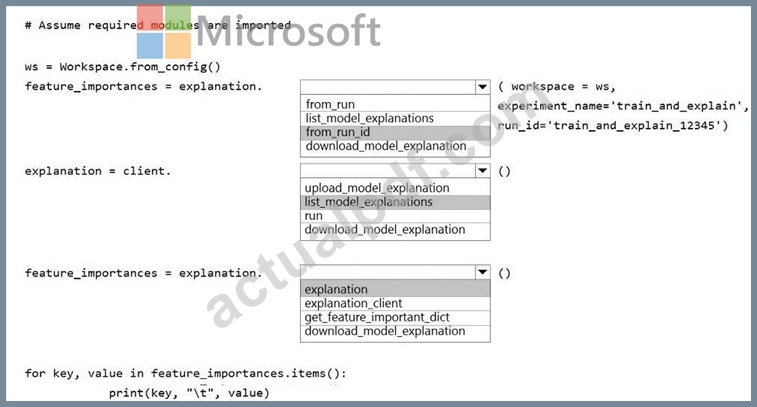
Box 1: from_run_id
from_run_id(workspace, experiment_name, run_id)
Create the client with factory method given a run ID.
Returns an instance of the ExplanationClient.
Parameters
* Workspace Workspace An object that represents a workspace.
* experiment_name str The name of an experiment.
* run_id str A GUID that represents a run.
Box 2: list_model_explanations
list_model_explanations returns a dictionary of metadata for all model explanations available.
Returns
A dictionary of explanation metadata such as id, data type, explanation method, model type, and upload time, sorted by upload time Box 3: explanation Reference:
https://docs.microsoft.com/en-us/python/api/azureml-contrib-interpret/azureml.contrib.interpret.explanation.expl
NEW QUESTION # 289
space and set up a development environment. You plan to train a deep neural network (DNN) by using the Tensorflow framework and by using estimators to submit training scripts.
You must optimize computation speed for training runs.
You need to choose the appropriate estimator to use as well as the appropriate training compute target configuration.
Which values should you use? To answer, select the appropriate options in the answer area.
NOTE: Each correct selection is worth one point.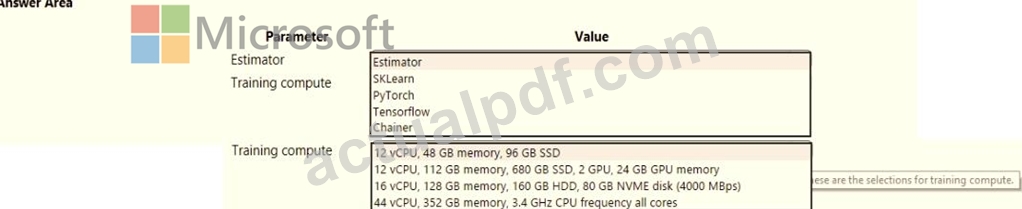
Answer:
Explanation: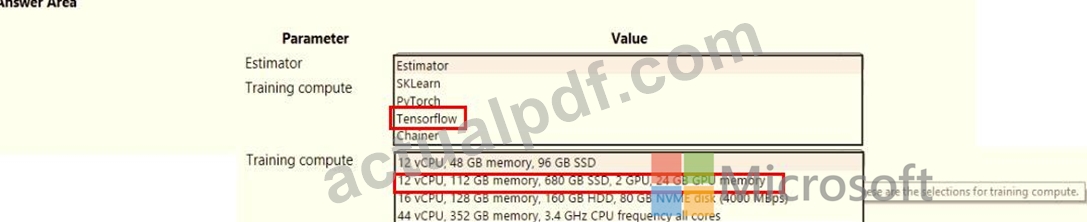
Reference:
https://docs.microsoft.com/en-us/python/api/azureml-train-core/azureml.train.dnn
NEW QUESTION # 290
You are data scientist building a deep convolutional neutral network (CNN) for image classification.
The CNN model you build shows signs of overfitting.
You need to reduce overfitting and converge the model to an optimal fit.
Which two actions should you perform? Each correct answer presents a complete solution.
NOTE: Each correct selection is worth one point.
- A. Add an additional dense layer with 64 input units.
- B. Add L1/L2 regularization.
- C. Use training data augmentation.
- D. Reduce the amount of training data.
- E. Add an additional dense layer with 512 input units.
Answer: B,D
Explanation:
B: Weight regularization provides an approach to reduce the overfitting of a deep learning neural network model on the training data and improve the performance of the model on new data, such as the holdout test set.
Keras provides a weight regularization API that allows you to add a penalty for weight size to the loss function.
Three different regularizer instances are provided; they are:
* L1: Sum of the absolute weights.
* L2: Sum of the squared weights.
* L1L2: Sum of the absolute and the squared weights.
D: Because a fully connected layer occupies most of the parameters, it is prone to overfitting. One method to reduce overfitting is dropout. At each training stage, individual nodes are either "dropped out" of the net with probability 1-p or kept with probability p, so that a reduced network is left; incoming and outgoing edges to a dropped-out node are also removed.
By avoiding training all nodes on all training data, dropout decreases overfitting.
References:
https://machinelearningmastery.com/how-to-reduce-overfitting-in-deep-learning-with-weight-regularization/
https://en.wikipedia.org/wiki/Convolutional_neural_network
NEW QUESTION # 291
You are tuning a hyperparameter for an algorithm. The following table shows a data set with different hyperparameter, training error, and validation errors.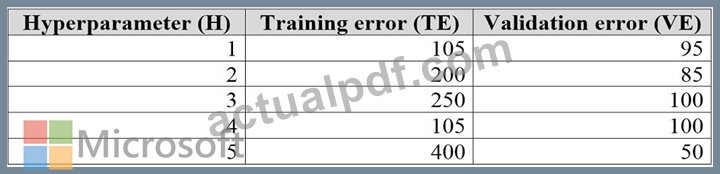
Use the drop-down menus to select the answer choice that answers each question based on the information presented in the graphic.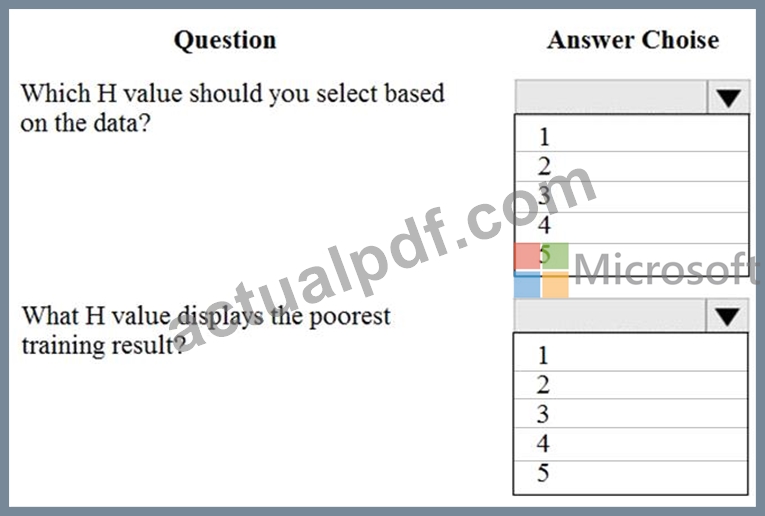
Answer:
Explanation: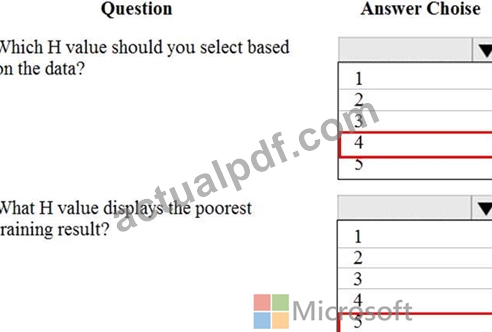
Explanation:
Box 1: 4
Choose the one which has lower training and validation error and also the closest match.
Minimize variance (difference between validation error and train error).
Box 2: 5
Minimize variance (difference between validation error and train error).
Reference:
https://medium.com/comet-ml/organizing-machine-learning-projects-project-management-guidelines-2d2b85651bbd
NEW QUESTION # 292
Note: This question is part of a series of questions that present the same scenario. Each question in the series contains a unique solution that might meet the stated goals. Some question sets might have more than one correct solution, while others might not have a correct solution.
After you answer a question in this section, you will NOT be able to return to it. As a result, these questions will not appear in the review screen.
You have a Python script named train.py in a local folder named scripts. The script trains a regression model by using scikit-learn. The script includes code to load a training data file which is also located in the scripts folder.
You must run the script as an Azure ML experiment on a compute cluster named aml-compute.
You need to configure the run to ensure that the environment includes the required packages for model training. You have instantiated a variable named aml-compute that references the target compute cluster.
Solution: Run the following code: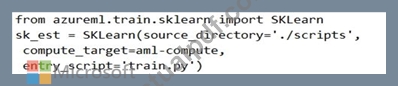
Does the solution meet the goal?
- A. No
- B. Yes
Answer: B
Explanation:
The scikit-learn estimator provides a simple way of launching a scikit-learn training job on a compute target.
It is implemented through the SKLearn class, which can be used to support single-node CPU training.
Example:
from azureml.train.sklearn import SKLearn
}
estimator = SKLearn(source_directory=project_folder,
compute_target=compute_target,
entry_script='train_iris.py'
)
Reference:
https://docs.microsoft.com/en-us/azure/machine-learning/how-to-train-scikit-learn
NEW QUESTION # 293
Hotspot Question
You manage an Azure Machine Learning workspace named workspace1 by using the Python SDK v2.
You must register datastores in workspace1 for Azure Blob and Azure Data Lake Gen2 storage to meet the following requirements:
- Data scientists accessing the datastore must have the same level of
access.
- Access must be restricted to specified containers or folders.
You need to configure a security access method used to register the Azure Blob and Azure Data Lake Gen2 storage in workspace1.
Which security access method should you configure? To answer, select the appropriate options in the answer area.
NOTE: Each correct selection is worth one point.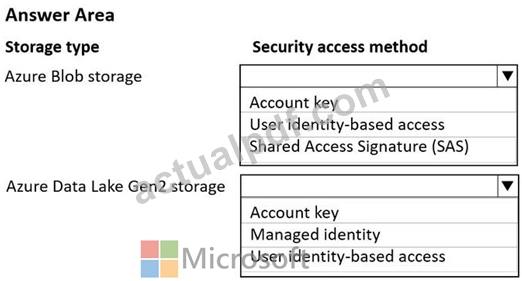
Answer:
Explanation: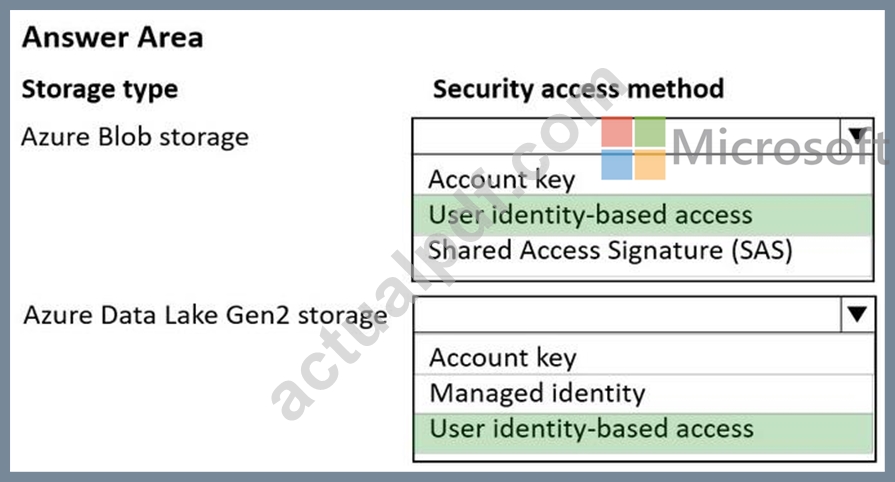
Explanation:
User identity-based access allows you to restrict access to the datastore to specific users or groups. This is the best option for your scenario because it ensures that all data scientists accessing the datastore have the same level of access, and it allows you to restrict access to specified containers or folders.
Account key and SAS tokens are both credential-based access methods. This means that the credentials for accessing the datastore are stored in the Azure Machine Learning workspace.
This is not ideal for your scenario because it would allow any user with Reader workspace access to access the datastore.
NEW QUESTION # 294
You have an Azure Machine Learning workspace.
You run the following code in a Python environment in which the configuration file for your workspace has been downloaded.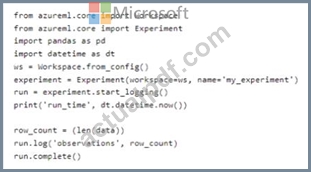
instructions: For each of the following statements, select Yes if the statement is true. Otherwise, select No.
NOTE: Each correct selection is worth one point.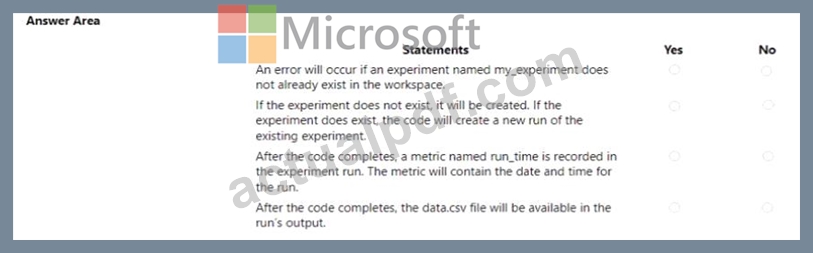
Answer:
Explanation: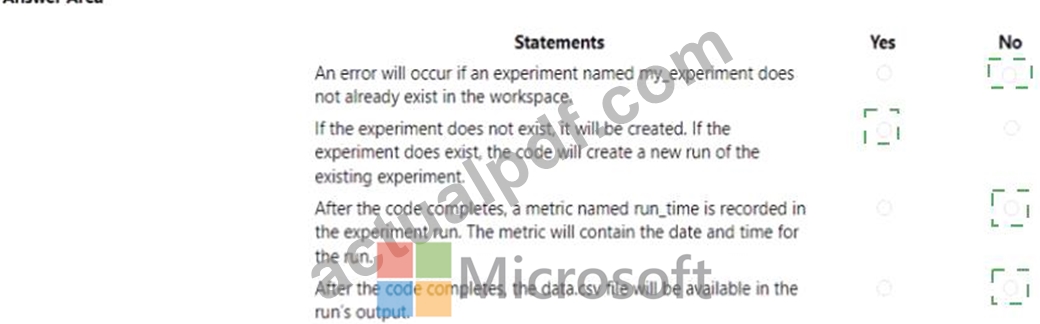
Explanation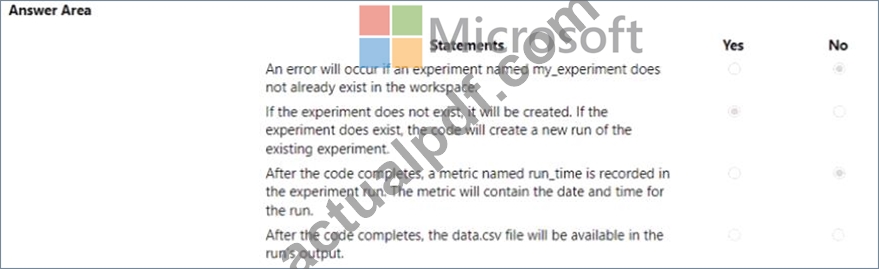
NEW QUESTION # 295
You have the following code. The code prepares an experiment to run a script: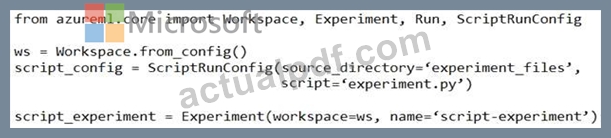
The experiment must be run on local computer using the default environment.
You need to add code to start the experiment and run the script.
Which code segment should you use?
- A. run = script_experiment.start_logging()
- B. run = Run(experiment=script_experiment)
- C. ws.get_run(run_id=experiment.id)
- D. run = script_experiment.submit(config=script_config)
Answer: D
Explanation:
Explanation
The experiment class submit method submits an experiment and return the active created run.
Syntax: submit(config, tags=None, **kwargs)
Reference:
https://docs.microsoft.com/en-us/python/api/azureml-core/azureml.core.experiment.experiment
NEW QUESTION # 296
You have a Python data frame named salesData in the following format:
The data frame must be unpivoted to a long data format as follows:
You need to use the pandas.melt() function in Python to perform the transformation.
How should you complete the code segment? To answer, select the appropriate options in the answer area.
NOTE: Each correct selection is worth one point.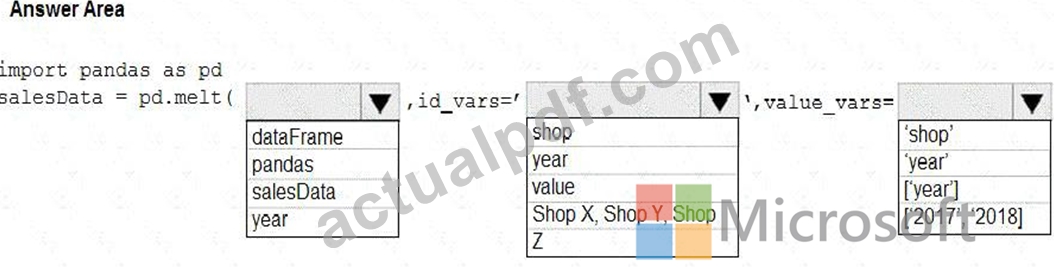
Answer:
Explanation: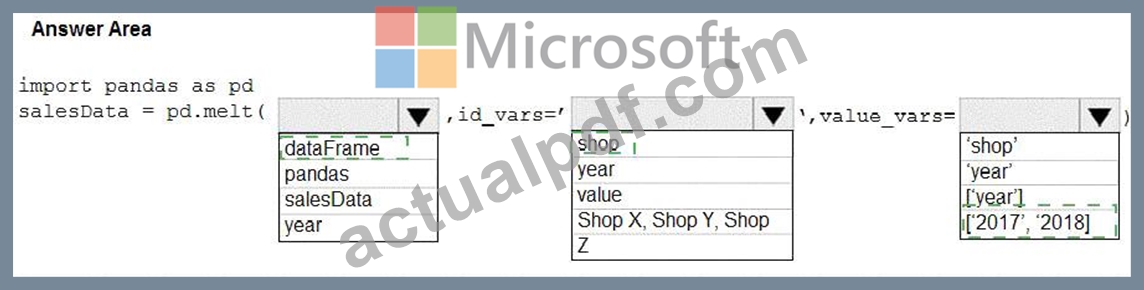
Explanation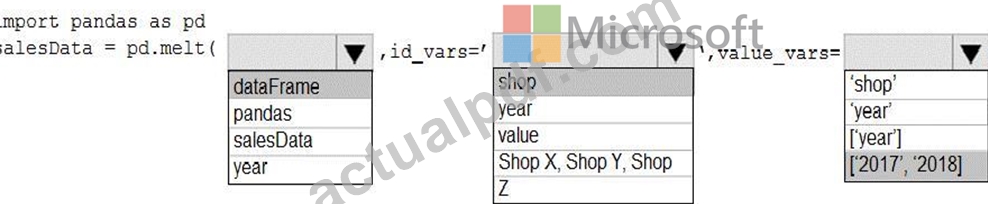
Box 1: dataFrame
Syntax: pandas.melt(frame, id_vars=None, value_vars=None, var_name=None, value_name='value', col_level=None)[source] Where frame is a DataFrame Box 2: shop Paramter id_vars id_vars : tuple, list, or ndarray, optional Column(s) to use as identifier variables.
Box 3: ['2017','2018']
value_vars : tuple, list, or ndarray, optional
Column(s) to unpivot. If not specified, uses all columns that are not set as id_vars.
Example:
df = pd.DataFrame({'A': {0: 'a', 1: 'b', 2: 'c'},
'B': {0: 1, 1: 3, 2: 5},
'C': {0: 2, 1: 4, 2: 6}})
pd.melt(df, id_vars=['A'], value_vars=['B', 'C'])
A variable value
0 a B 1
1 b B 3
2 c B 5
3 a C 2
4 b C 4
5 c C 6
References:
https://pandas.pydata.org/pandas-docs/stable/reference/api/pandas.melt.html
NEW QUESTION # 297
You use Azure Machine Learning to train a model. You must use Bayesian sampling to tune hyperparameters.
You need to select a ieaming_rate parameter distribution.
Which two distributions can you use? Each correct answer presents a complete solution. NOTE: Each correct selection is worth one point.
- A. Normal
- B. Uniform
- C. LogUniform
- D. Choice
- E. QNormal
Answer: B,D
NEW QUESTION # 298
You use the Azure Machine Learning SDK in a notebook to run an experiment using a script file in an experiment folder.
The experiment fails.
You need to troubleshoot the failed experiment.
What are two possible ways to achieve this goal? Each correct answer presents a complete solution.
- A. View the log files for the experiment run in the experiment folder.
- B. Use the get_output() method of the run object to retrieve the experiment run logs.
- C. Use the get_details_with_logs() method of the run object to display the experiment run logs.
- D. View the logs for the experiment run in Azure Machine Learning studio.
- E. Use the get_metrics() method of the run object to retrieve the experiment run logs.
Answer: C,D
Explanation:
Use get_details_with_logs() to fetch the run details and logs created by the run.
You can monitor Azure Machine Learning runs and view their logs with the Azure Machine Learning studio.
Reference:
https://docs.microsoft.com/en-us/python/api/azureml-pipeline-core/azureml.pipeline.core.steprun
https://docs.microsoft.com/en-us/azure/machine-learning/how-to-monitor-view-training-logs
Topic 1, Case Study 1
Overview
You are a data scientist in a company that provides data science for professional sporting events. Models will be global and local market data to meet the following business goals:
*Understand sentiment of mobile device users at sporting events based on audio from crowd reactions.
*Access a user's tendency to respond to an advertisement.
*Customize styles of ads served on mobile devices.
*Use video to detect penalty events.
Current environment
Requirements
* Media used for penalty event detection will be provided by consumer devices. Media may include images and videos captured during the sporting event and snared using social media. The images and videos will have varying sizes and formats.
* The data available for model building comprises of seven years of sporting event media. The sporting event media includes: recorded videos, transcripts of radio commentary, and logs from related social media feeds feeds captured during the sporting events.
*Crowd sentiment will include audio recordings submitted by event attendees in both mono and stereo Formats.
Advertisements
* Ad response models must be trained at the beginning of each event and applied during the sporting event.
* Market segmentation nxxlels must optimize for similar ad resporr.r history.
* Sampling must guarantee mutual and collective exclusivity local and global segmentation models that share the same features.
* Local market segmentation models will be applied before determining a user's propensity to respond to an advertisement.
* Data scientists must be able to detect model degradation and decay.
* Ad response models must support non linear boundaries features.
* The ad propensity model uses a cut threshold is 0.45 and retrains occur if weighted Kappa deviates from 0.1
+/-5%.
* The ad propensity model uses cost factors shown in the following diagram: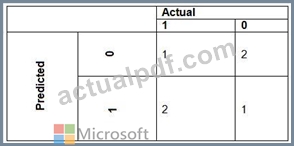
The ad propensity model uses proposed cost factors shown in the following diagram: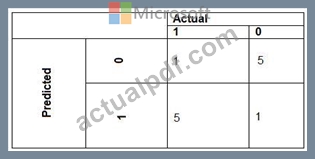
Performance curves of current and proposed cost factor scenarios are shown in the following diagram: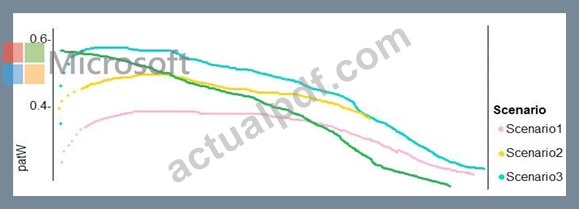
Penalty detection and sentiment
Findings
*Data scientists must build an intelligent solution by using multiple machine learning models for penalty event detection.
*Data scientists must build notebooks in a local environment using automatic feature engineering and model building in machine learning pipelines.
*Notebooks must be deployed to retrain by using Spark instances with dynamic worker allocation
*Notebooks must execute with the same code on new Spark instances to recode only the source of the data.
*Global penalty detection models must be trained by using dynamic runtime graph computation during training.
*Local penalty detection models must be written by using BrainScript.
* Experiments for local crowd sentiment models must combine local penalty detection data.
* Crowd sentiment models must identify known sounds such as cheers and known catch phrases. Individual crowd sentiment models will detect similar sounds.
* All shared features for local models are continuous variables.
* Shared features must use double precision. Subsequent layers must have aggregate running mean and standard deviation metrics Available.
segments
During the initial weeks in production, the following was observed:
*Ad response rates declined.
*Drops were not consistent across ad styles.
*The distribution of features across training and production data are not consistent.
Analysis shows that of the 100 numeric features on user location and behavior, the 47 features that come from location sources are being used as raw features. A suggested experiment to remedy the bias and variance issue is to engineer 10 linearly uncorrected features.
Penalty detection and sentiment
*Initial data discovery shows a wide range of densities of target states in training data used for crowd sentiment models.
*All penalty detection models show inference phases using a Stochastic Gradient Descent (SGD) are running too stow.
*Audio samples show that the length of a catch phrase varies between 25%-47%, depending on region.
*The performance of the global penalty detection models show lower variance but higher bias when comparing training and validation sets. Before implementing any feature changes, you must confirm the bias and variance using all training and validation cases.
NEW QUESTION # 299
You create an Azure Machine Learning workspace.
You need to detect data drift between a baseline dataset and a subsequent target dataset by using the DataDriftDetector class.
How should you complete the code segment? To answer, select the appropriate options in the answer area.
NOTE: Each correct selection is worth one point.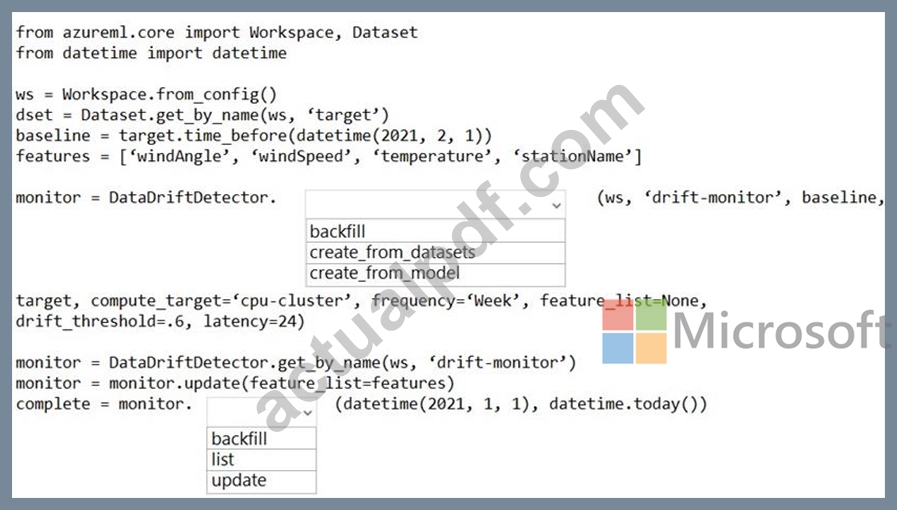
Answer:
Explanation: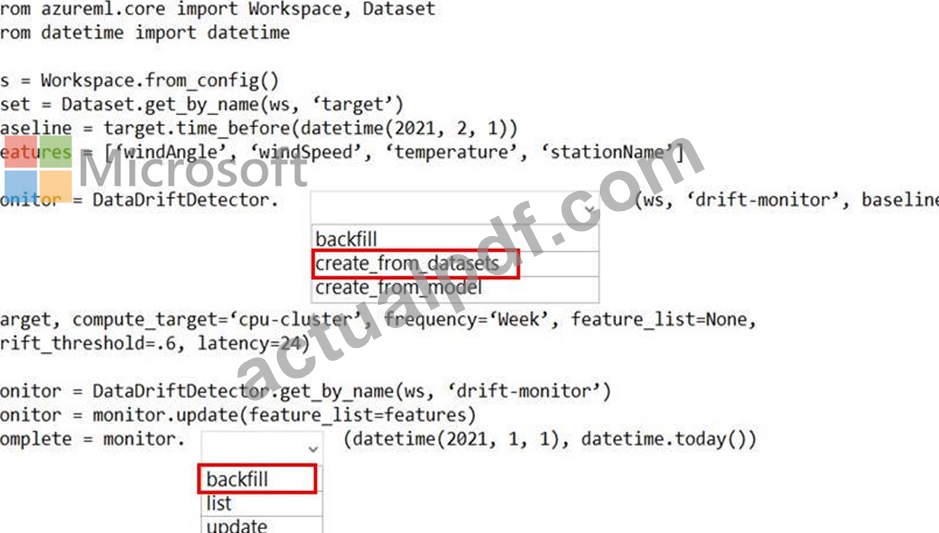
Reference:
https://docs.microsoft.com/en-us/python/api/azureml-datadrift/azureml.datadrift.datadriftdetector(class)
NEW QUESTION # 300
You must use in Azure Data Science Virtual Machine (DSVM) as a compute target.
You need to attach an existing DSVM to the workspace by using the Azure Machine Learning SDK for Python.
How should you complete the following code segment? To answer, select the appropriate options in the answer area.
NOTE: Each correct selection is worth one point.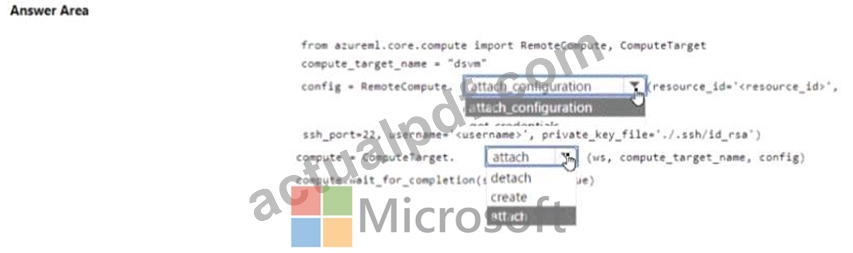
Answer:
Explanation: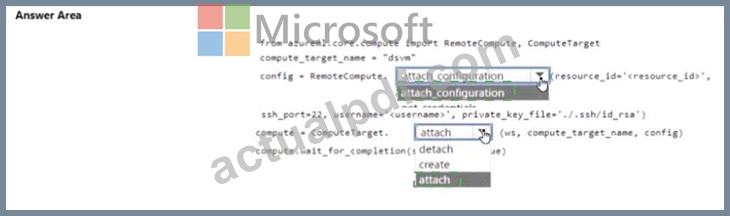
Explanation: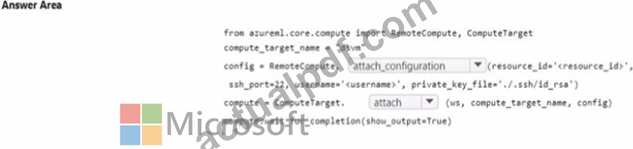
NEW QUESTION # 301
You configure a Deep Learning Virtual Machine for Windows.
You need to recommend tools and frameworks to perform the following:
Build deep rwur.il network (DNN) models.
Perform interactive data exploration and visualization.
Which tools and frameworks should you recommend? To answer, drag the appropriate tools to the correct tasks. Each tool may be used once, more than once, or not at all. You may need to drag the split bar between panes or scroll to view content.
NOTE: Each correct selection is worth one point.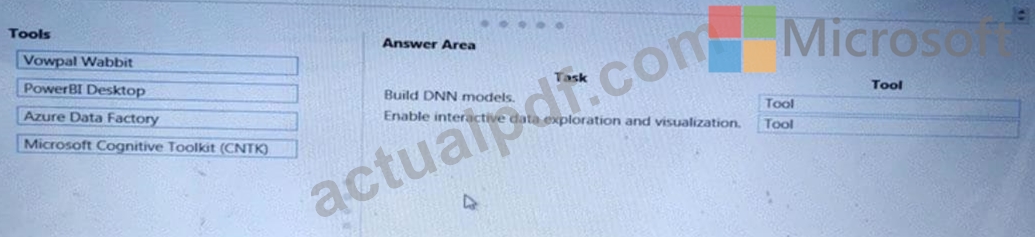
Answer:
Explanation: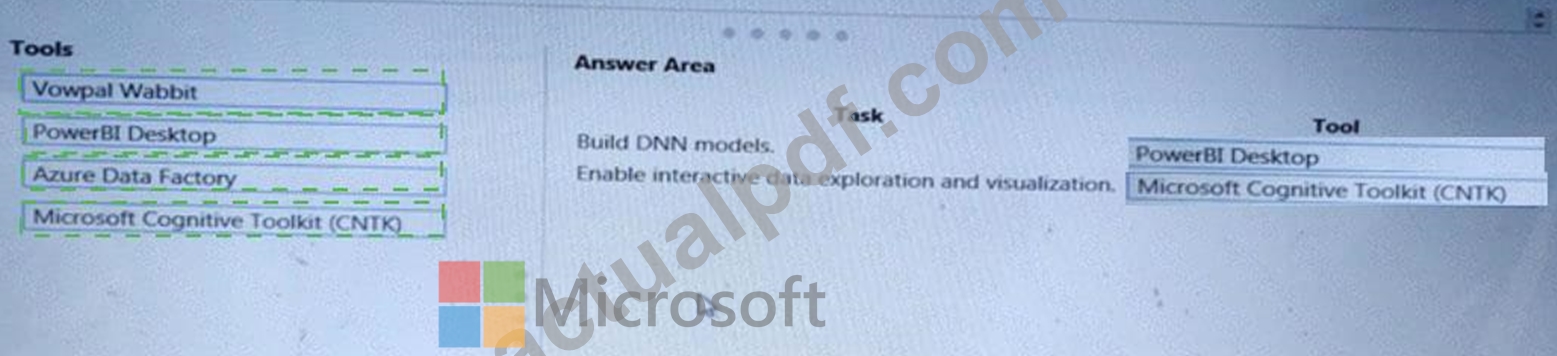
NEW QUESTION # 302
......
Achieving the Microsoft DP-100 certification is a great way to showcase your data science skills and enhance your career prospects. Designing and Implementing a Data Science Solution on Azure certification validates your ability to design and implement data science solutions on Azure, which is one of the most popular cloud platforms for data science and AI workloads. By passing the DP-100 exam, you can demonstrate your proficiency in using Azure tools and services to build intelligent solutions that can help organizations make better decisions and improve their business outcomes.
Microsoft DP-100: Designing and Implementing a Data Science Solution on Azure is a certification exam designed for data professionals who want to demonstrate their skills in designing and implementing data science solutions on Azure. It is intended for individuals who work with data engineers, data scientists, and other stakeholders in the organization to create and deploy end-to-end data science solutions.
DP-100 Certification All-in-One Exam Guide Jun-2026: https://dumpstorrent.actualpdf.com/DP-100-real-questions.html
