

100% Real & Accurate CTFL_Syll_4.0 Questions and Answers with Free and Fast Updates
Get Unlimited Access to CTFL_Syll_4.0 Certification Exam Cert Guide
NEW QUESTION # 88
Which sequence of state transitions is INCORRECT in accordance with the following description?
To provide for disaster recovery a system (designated as A) has been provided with a backup system (designated as B). Only one of them can be active at a time. When A goes down, B becomes active. When A comes back up then B becomes inactive and A becomes active again. However, when A is down and B also goes down then a message is sent to the system administrator. After this once A comes back up, A becomes active or if B comes up then B becomes Active.
- A. A is active and B is inactive. A goes down. B becomes active then B goes down. A is made active
- B. A and B are both down then A and B both come back up at the same time. A should become the active system and B should be inactive
- C. A is active and B is inactive then A goes down, B becomes active.
- D. A comes up when B is active and A was down. Now A becomes active and B becomes inactive.
Answer: B
Explanation:
According to the description provided, when both systems A and B come back up at the same time, the process should involve a decision about which system should become active. However, the description states that if both systems come up simultaneously, one should become active based on a specific condition or precedence. Generally, in disaster recovery systems, there are protocols to avoid both systems becoming active simultaneously to prevent conflicts. Therefore, the transition where both A and B come back up at the same time and A becomes active while B becomes inactive without any conflict or decision-making step is incorrect.
NEW QUESTION # 89
A software development company invests heavily in tools to support the entire software development lifecycle, including testing. They have a tool that allows automated creation and installation of builds and subsequent execution of various types of automated tests. Which ONE of the following is a CORRECT statement about this type of test tool?
- A. It is an example of test implementation tool
- B. It is an example of collaboration tool
- C. It is an example of DevOps related tools
- D. It is an example of automated unit testing tool
Answer: C
Explanation:
The tool described in the question supports the automated creation and installation of builds and the execution of various types of automated tests. This aligns with the practices and tools typically found in DevOps environments, which aim to integrate and automate the processes between software development and IT teams. DevOps tools facilitate continuous integration (CI) and continuous delivery (CD), enabling automated building, testing, and deployment of applications. Therefore, the correct answer is that this is an example of DevOps related tools.
NEW QUESTION # 90
Which ONE of the following statements about maintenance testing is CORRECT?
- A. Maintenance testing does not require test cases since it focuses solely on defect verification.
- B. Maintenance testing is only required when defects are reported in production.
- C. Maintenance testing should be performed when enhancements, fixes, or updates are applied to an existing system.
- D. Maintenance testing is performed exclusively for adaptive maintenance.
Answer: C
Explanation:
Maintenance testing is carried outwhenever changes are made to an existing system, including enhancements, defect fixes, and system migrations (C). It is not limited to adaptive maintenance (A) and is needed even when no defects are reported (B). Test cases are essential to validate fixes and prevent regressions (D).
NEW QUESTION # 91
Which of the following statements is CORRECT about White-box testing?
- A. White-box testing helps find defects even when specifications are vague because it takes into account the code.
- B. White-box testing helps find defects because it focuses on defects rather than failures
- C. White-box testing helps find defects because they can be used to measure statement coverage
- D. White-box testing helps find defects because it provides for requirements based coverage
Answer: C
Explanation:
White-box testing, also known as structural testing, involves testing the internal structures or workings of an application, as opposed to its functionality (which is tested by black-box testing). The correct statement about white-box testing is that it helps find defects by measuring aspects such as statement coverage.
* Statement Coverage: White-box testing techniques like statement coverage measure whether each statement in the code has been executed at least once. This helps ensure that all parts of the code are tested and can reveal defects in areas that might not be reached by black-box testing alone.
Other statements are less accurate in the context of white-box testing:
* Specifications being vague: White-box testing is code-focused, not requirement-focused. If specifications are vague, it affects both white-box and black-box testing. The main advantage of white- box testing is that it allows testers to create tests based on the code's structure and logic.
* Requirements-based coverage: This is typically associated with black-box testing, which derives tests from specifications and requirements. White-box testing, on the other hand, derives tests from the code itself.
* Focus on defects rather than failures: Both white-box and black-box testing aim to identify defects, but white-box testing does this through code coverage and examining the code paths directly. It does not focus exclusively on defects rather than failures; it is just another method to identify potential issues.
NEW QUESTION # 92
The fact that defects are usually not evenly distributed among the various modules that make up a software application, but rather their distribution tend to reflect the Pareto principle:
- A. is expressed by the testing principle referred to as Tests wear out'
- B. is a false myth
- C. is expressed by the testing principle referred to as 'Defects cluster together'
- D. is expressed by the testing principle referred to as 'Bug prediction'
Answer: C
Explanation:
Explanation
The fact that defects are usually not evenly distributed among the various modules that make up a software application, but rather their distribution tend to reflect the Pareto principle, is expressed by the testing principle referred to as 'Defects cluster together'. This principle states that a small number of modules contain most of the defects detected, or that a small number of causes are responsible for most of the defects. This principle can be used to guide the test analysis and design activities, by prioritizing the testing of the most critical or risky modules, or by applying more rigorous test techniques to them. Therefore, option C is the correct answer.
References: ISTQB Certified Tester Foundation Level Syllabus v4.01, Section 1.2.1, page 11; ISTQB Glossary v4.02, page 16.
NEW QUESTION # 93
Consider an estimation session where a six-member Agile team (Memb1, ... , Memb6) is performing a planning poker session to estimate a user story (in story points). Team members are using a set of cards with the following values: 1, 2, 3, 5, 8, 13, 21. Below is the outcome produced by the first round of estimation for this session:
Which of the following answers best describes how the estimation session should proceed?
- A. The final estimate of the user story in story points is determined as the arithmetic mean of all the estimates made by the team members during this first round, without the need to perform further rounds of estimation
- B. The final estimate of the user story in story points is determined as the arithmetic mean of the most optimistic estimate (chosen by Memb6) and the most pessimistic estimate (chosen by Memb4) during this first round, without the need to perform further rounds of estimation
- C. The final estimation of the user story in story points is determined as the most frequent estimate value among those selected by the team members (in this case 3 story points chosen by Memb1, Memb2, Memb3, Memb5) during this first round, without the need to perform further rounds of estimation
- D. Memb4 and Memb6, which have produced the most pessimistic and the most optimistic estimates respectively, should explain the reasons of their choices to stimulate a discussion between all team members before to proceed to another round of estimation
Answer: D
Explanation:
In Agile estimation sessions, particularly during Planning Poker, the goal is to reach a consensus on the effort required for a user story. The process encourages discussion and collaboration among team members to understand the story's requirements and complexities fully. Here's a breakdown of the options and why D is the correct choice:
Option A: Calculating the arithmetic mean of all estimates.
* This method is straightforward but does not facilitate team discussion or consensus-building. It merely averages out the estimates without addressing the reasons behind the varying estimates. Thus, important insights and understanding of the task complexity might be missed.
Option B: Selecting the most frequent estimate value.
* While this approach acknowledges the majority's opinion, it ignores the minority views, which might highlight significant aspects of the story that need consideration. It doesn't ensure that all perspectives are considered and discussed.
Option C: Calculating the mean of the most optimistic and pessimistic estimates.
* This approach considers the extremes but again lacks the team discussion and consensus aspect. It also assumes that the extreme values alone can balance out the estimate, which might not always capture the true complexity or simplicity of the task.
Option D: Discussing the most pessimistic and optimistic estimates.
* This approach fosters team collaboration and understanding. Memb4 and Memb6 explain their reasoning for the highest and lowest estimates, respectively, which can reveal different perspectives on the task's complexity. This discussion helps the team align their understanding and often leads to a more accurate and agreed-upon estimate in subsequent rounds.
In conclusion, the main goal of Agile estimation techniques like Planning Poker is to encourage team communication and collaboration to ensure that all aspects of the user story are considered. Option D best aligns with this goal by promoting discussion and consensus.
NEW QUESTION # 94
As a result of the joint evaluation of a product version with the customer, it has been concluded that it would be appropriate to retrieve an earlier version of the product and carry out a benchmark. Depending on the result, further development will be carried out based on the current version or the retrieved version.
Which mechanism, process, and/or technique will allow the specific version (including the testing work products) of a given software product to be restored?
- A. Change management
- B. Defect management
- C. Risk management
- D. Configuration management
Answer: D
Explanation:
Configuration management (B)ensures thatversions of software and test artifactsare properly tracked, stored, and retrievable. It allows teams to:
* Restoreearlier versions of software and test work products
* Maintaintraceability between requirements, tests, and code
* Avoid discrepancies due tomismanaged versions
* (A) is incorrectbecause defect managementtracks issues but does not restore versions.
* (C) is incorrectbecause change managementcontrols changes but does not track past versions.
* (D) is incorrectbecause risk managementassesses risks but does not manage software versions.
Effective configuration management ensures the ability to roll back changesand maintain system stability.
Reference:ISTQB CTFL v4.0 Syllabus, Section 5.4 - Configuration Management
NEW QUESTION # 95
Consider a review for a high-level architectural document written by a software architect. The architect does most of the review preparation work, including distributing the document to reviewers before the review meeting. However, reviewers are not required to analyze the document in advance, and during the review meeting the software architect explains the document step by step. The only goal of this review is to establish a common understanding of the software architecture that will be used in a software development project.
Which of the following review types does this review refer to?
- A. Inspection
- B. Walkthrough
- C. Informal review
- D. Audit
Answer: B
Explanation:
Explanation
This answer is correct because a walkthrough is a type of review where the author of the work product leads the review process and explains the work product to the reviewers. The reviewers are not required to prepare for the review in advance, and the main objective of the walkthrough is to establish a common understanding of the work product and to identify any major defects or issues. A walkthrough is usually informal and does not follow a defined process or roles. In this case, the review for a high-level architectural document written by a software architect matches the characteristics of a walkthrough. References: ISTQB Glossary of Testing Terms v4.0, ISTQB Foundation Level Syllabus v4.0, Section 2.4.2.2
NEW QUESTION # 96
Use Scenario 1 "Happy Tomatoes" (from the previous question).
Using theBoundary Value Analysis (BVA)technique (in its two-point variant), identify the set of input values that provides the HIGHEST coverage.
- A. {7,8,22,23,29,30}
- B. {7,8,21,22,29,30}
- C. {6,7,21,22,29,30}
- D. {6,7,8,21,22,29,31}
Answer: B
Explanation:
Boundary Value Analysis (BVA)focuses on test cases at the edges of partitions because defects often occur at boundaries. The temperature ranges are:
* #7 (Too cold # W)
* [8-21] (Standstill # X)
* [22-29] (Ideal # Y)
* #30 (Too hot # Z)
Atwo-point BVAmeans testing both thelower and upper boundary valuesof each partition.The correct selection{7,8,21,22,29,30}includes:
* 7 # Boundary of Too Cold (W)
* 8 # Lower boundary of Standstill (X)
* 21 # Upper boundary of Standstill (X)
* 22 # Lower boundary of Ideal (Y)
* 29 # Upper boundary of Ideal (Y)
* 30 # Lower boundary of Too Hot (Z)
This ensures maximum boundary coverage.
NEW QUESTION # 97
Which ONE of the following options is aPRODUCT riskand NOT aPROJECT risk?
- A. Delays in the delivery of work products by the project team.
- B. Poor communication between team members, making project management more difficult.
- C. Incorrect calculation logic in the software, leading to inaccurate results.
- D. Staff shortages in the project leading to scheduling problems.
Answer: C
Explanation:
Product risksare risks thatimpact the quality or functionality of the software, whereasproject risksaffect theprocess, resources, or timeline.
* (A) is correctbecause incorrect calculations impact software correctness.
* (B), (C), and (D) are project risksas they relate toteam coordination, staffing, and schedulingrather than software defects.
Identifyingproduct risksearlyimproves defect detection and ensures better coverage for high-risk areas.
NEW QUESTION # 98
Given some statements about independence of testing
i.Independence is a replacement for familiarity with the code
ii.Independence helps remove the biases produced because of own work
iii.Similar kind of failures can be detected by anyone
iv.Assumptions by different people are different revealing weaknesses Which of the following CORRECTLY represents the benefits?
- A. ii and iv
- B. i and iii
- C. iii and iv
- D. i and iv
Answer: A
Explanation:
Independence in testing provides several benefits. Firstly, it helps remove the biases that might be introduced by the person who developed the code or created the tests (ii). This is because an independent tester can evaluate the software without being influenced by their prior work. Secondly, different people bring different perspectives and assumptions to the testing process, which can help uncover different types of weaknesses (iv).
References:
* ISTQB CTFL Syllabus V4.0, Section 1.5.3 on the benefits of independence in testing, which emphasizes the reduction of bias and the introduction of diverse viewpoints.
NEW QUESTION # 99
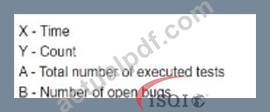
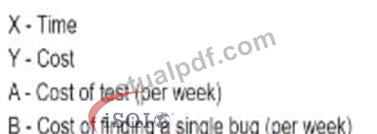
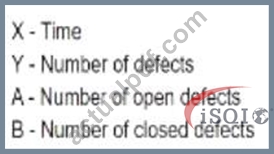
The following chart represents metrics related to testing of a project that was competed. Indicate what is represented by tie lines A, B and the axes X.Y
- A.
- B.
- C.
Answer: A
Explanation:
Option C correctly explains what is represented by the lines A, B and the axes X, Y in a testing metrics chart.
According to option D:
* X-axis represents Time
* Y-axis represents Count
* Line A represents Number of open bugs
* Line B represents Total number of executed tests
This information is essential in understanding and analyzing the testing metrics of a completed project.
References: ISTQB Certified Tester Foundation Level (CTFL) v4.0 Syllabus, Section 2.5.1, Page 35.
NEW QUESTION # 100
The whole-team approach:
- A. promotes the idea that all team members should be responsible for the quality of the product
- B. is mostly adopted in projects aimed at developing safety-critical systems, as it ensures the highest level of testing independence
- C. is a consensus-based approach that engages the whole team in estimating the user stories
- D. promotes the idea that all team members should have a thorough understanding of test techniques
Answer: A
Explanation:
This answer is correct because the whole-team approach is a way of working in agile projects where all team members share the responsibility for the quality of the product, and collaborate on delivering value to the customer. The whole-team approach involves testers, developers, business analysts, product owners, and other stakeholders in planning, designing, developing, testing, and delivering the product. The whole-team approach fosters communication, feedback, learning, and continuous improvement within the team. References: ISTQB Glossary of Testing Terms v4.0, ISTQB Foundation Level Syllabus v4.0, Section 3.1.1.1
NEW QUESTION # 101
Which of the following statements about how different types of test tools support testers is true?
- A. The support offered by a continuous integration tool is often leveraged by testers to automatically generate test cases from a model
- B. The support offered by a test data preparation tool is often leveraged by testers to run automated regression test suites
- C. The support offered by a bug prediction tool is often used by testers to track the bugs they found
- D. The support offered by a performance testing tool is often leveraged by testers to run load tests
Answer: D
Explanation:
The support offered by a performance testing tool is often leveraged by testers to run load tests, which are tests that simulate a large number of concurrent users or transactions on the system under test, in order to measure its performance, reliability, and scalability. Performance testing tools can help testers to generate realistic workloads, monitor system behavior, collect and analyze performance metrics, and identify performance bottlenecks. The other statements are false, because:
* A test data preparation tool is a tool that helps testers to create, manage, and manipulate test data, which are the inputs and outputs of test cases. Test data preparation tools are not directly related to running automated regression test suites, which are test suites that verify that the system still works as expected after changes or modifications. Regression test suites are usually executed by test execution tools, which are tools that can automatically run test cases and compare actual results with expected results.
* A bug prediction tool is a tool that uses machine learning or statistical techniques to predict the likelihood of defects in a software system, based on various factors such as code complexity, code churn, code coverage, code smells, etc. Bug prediction tools are not used by testers to track the bugs they found, which are the actual defects that have been detected and reported during testing. Bugs are usually tracked by defect management tools, which are tools that help testers to record, monitor, analyze, and resolve defects.
* A continuous integration tool is a tool that enables the integration of code changes from multiple developers into a shared repository, and the execution of automated builds and tests, in order to ensure the quality and consistency of the software system. Continuous integration tools are not used by testers to automatically generate test cases from a model, which are test cases that are derived from a representation of the system under test, such as a state diagram, a decision table, a use case, etc. Test cases can be automatically generated by test design tools, which are tools that support the implementation and maintenance of test cases, based on test design specifications or test models.
References: ISTQB Certified Tester Foundation Level (CTFL) v4.0 sources and documents:
* ISTQB Certified Tester Foundation Level Syllabus v4.0, Chapter 3.4.1, Types of Test Tools
* ISTQB Glossary of Testing Terms v4.0, Performance Testing Tool, Test Data Preparation Tool, Bug Prediction Tool, Continuous Integration Tool, Test Execution Tool, Defect Management Tool, Test Design Tool
NEW QUESTION # 102
Which of the following statements about exploratory testing is true?
- A. Exploratory testing is an experience-based test technique in which testers explore the requirements specification to detect non testable requirements
- B. When exploratory testing is conducted following a session-based approach, the issues detected by the testers can be documented in session sheets
- C. Exploratory testing is an experience-based test technique used by testers during informal code reviews to find defects by exploring the source code
- D. In exploratory testing, testers usually produce scripted tests and establish bidirectional traceability between these tests and the items of the test basis
Answer: B
Explanation:
Exploratory testing is an experience-based test technique in which testers dynamically design and execute tests based on their knowledge, intuition, and learning of the software system, without following predefined test scripts or test cases. Exploratory testing can be conducted following a session-based approach, which is a structured way of managing and measuring exploratory testing. In a session-based approach, the testers perform uninterrupted test sessions, usually lasting between 60 and 120 minutes, with a specific charter or goal, and document the issues detected, the test coverage achieved, and the time spent in session sheets. Session sheets are records of the test activities, results, and observations during a test session, which can be used for reporting, debriefing, and learning purposes. The other statements are false, because:
Exploratory testing is not a test technique in which testers explore the requirements specification to detect non testable requirements, but rather a test technique in which testers explore the software system to detect functional and non-functional defects, as well as to learn new information, risks, or opportunities. Non testable requirements are requirements that are ambiguous, incomplete, inconsistent, or not verifiable, which can affect the quality and effectiveness of the testing process. Non testable requirements can be detected by applying static testing techniques, such as reviews or inspections, to the requirements specification, before the software system is developed or tested.
Exploratory testing is not a test technique used by testers during informal code reviews to find defects by exploring the source code, but rather a test technique used by testers during dynamic testing to find defects by exploring the behavior and performance of the software system, without examining the source code. Informal code reviews are static testing techniques, in which the source code is analyzed by one or more reviewers, without following a formal process or using a checklist, to identify defects, violations, or improvements. Informal code reviews are usually performed by developers or peers, not by testers.
In exploratory testing, testers usually do not produce scripted tests and establish bidirectional traceability between these tests and the items of the test basis, but rather produce unscripted tests and adapt them based on the feedback and the findings of the testing process. Scripted tests are tests that are designed and documented in advance, with predefined inputs, outputs, and expected results, and are executed according to a test plan or a test procedure. Bidirectional traceability is the ability to trace both forward and backward the relationships between the items of the test basis, such as the requirements, the design, the risks, etc., and the test artifacts, such as the test cases, the test results, the defects, etc. Scripted tests and bidirectional traceability are usually associated with more formal and structured testing approaches, such as specification-based or structure-based test techniques, not with exploratory testing. Reference: ISTQB Certified Tester Foundation Level (CTFL) v4.0 sources and documents:
ISTQB® Certified Tester Foundation Level Syllabus v4.0, Chapter 2.2.3, Experience-based Test Design Techniques1 ISTQB® Glossary of Testing Terms v4.0, Exploratory Testing, Session-based Testing, Session Sheet, Non Testable Requirement, Static Testing, Informal Review, Dynamic Testing, Scripted Testing, Bidirectional Traceability2
NEW QUESTION # 103
Which ONE of the following elements is TYPICALLY part of the test plan?
- A. The budget and schedule for the test project.
- B. A detailed analysis of the defects found and their causes.
- C. A list of test logs from the test execution.
- D. A detailed report on the test results after the test project is completed.
Answer: A
Explanation:
Comprehensive and Detailed Explanation From Exact Extract:
The test plan is a key document in test management that outlines how testing will be performed for a particular project or product. According to the ISTQB CTFL Syllabus:
"A test plan is a work product that describes the objectives, scope, approach, and focus of a software testing effort... It typically includes details such as schedule, budget, resources, deliverables, risks, and entry and exit criteria." (ISTQB CTFL Syllabus v4.0, Section 5.1.1 - Purpose and Content of a Test Plan, Page 47) Options B, C, and D are not part of thetest planbut belong totest reportsortest executiondocumentation.
NEW QUESTION # 104
Consider an estimation session where a six-member Agile team (Memb1, ... , Memb6) is performing a planning poker session to estimate a user story (in story points). Team members are using a set of cards with the following values: 1, 2, 3, 5, 8, 13, 21. Below is the outcome produced by the first round of estimation for this session:
Which of the following answers best describes how the estimation session should proceed?
- A. The final estimate of the user story in story points is determined as the arithmetic mean of all the estimates made by the team members during this first round, without the need to perform further rounds of estimation
- B. The final estimate of the user story in story points is determined as the arithmetic mean of the most optimistic estimate (chosen by Memb6) and the most pessimistic estimate (chosen by Memb4) during this first round, without the need to perform further rounds of estimation
- C. The final estimation of the user story in story points is determined as the most frequent estimate value among those selected by the team members (in this case 3 story points chosen by Memb1, Memb2, Memb3, Memb5) during this first round, without the need to perform further rounds of estimation
- D. Memb4 and Memb6, which have produced the most pessimistic and the most optimistic estimates respectively, should explain the reasons of their choices to stimulate a discussion between all team members before to proceed to another round of estimation
Answer: D
Explanation:
In Agile estimation sessions, particularly during Planning Poker, the goal is to reach a consensus on the effort required for a user story. The process encourages discussion and collaboration among team members to understand the story's requirements and complexities fully. Here's a breakdown of the options and why D is the correct choice:
Option A:Calculating the arithmetic mean of all estimates.
* This method is straightforward but does not facilitate team discussion or consensus-building. It merely averages out the estimates without addressing the reasons behind the varying estimates. Thus, important insights and understanding of the task complexity might be missed.
Option B:Selecting the most frequent estimate value.
* While this approach acknowledges the majority's opinion, it ignores the minority views, which might highlight significant aspects of the story that need consideration. It doesn't ensure that all perspectives are considered and discussed.
Option C:Calculating the mean of the most optimistic and pessimistic estimates.
* This approach considers the extremes but again lacks the team discussion and consensus aspect. It also assumes that the extreme values alone can balance out the estimate, which might not always capture the true complexity or simplicity of the task.
Option D:Discussing the most pessimistic and optimistic estimates.
* This approach fosters team collaboration and understanding. Memb4 and Memb6 explain their reasoning for the highest and lowest estimates, respectively, which can reveal different perspectives on the task's complexity. This discussion helps the team align their understanding and often leads to a more accurate and agreed-upon estimate in subsequent rounds.
In conclusion, the main goal of Agile estimation techniques like Planning Poker is to encourage team communication and collaboration to ensure that all aspects of the user story are considered. Option D best aligns with this goal by promoting discussion and consensus.
NEW QUESTION # 105
During component testing of a program if 100% decision coverage is achieved, which of the following coverage criteria is also guaranteed to be 100%?
- A. 100% Boundary value coverage
- B. 100% Equivalence class coverage
- C. 100% Statement coverage
- D. 100% Stale transition coverage
Answer: C
Explanation:
Statement coverage is a structural coverage metric that measures the percentage of executable statements in the source code that are executed by a test suite1. Decision coverage is another structural coverage metric that measures the percentage of decision outcomes (such as branches or conditions) in the source code that are executed by a test suite1. Decision coverage is a stronger metric than statement coverage, because it requires that every possible outcome of each decision is tested, while statement coverage only requires that every statement is executed at least once2. Therefore, if a test suite achieves 100% decision coverage, it also implies that it achieves 100% statement coverage, because every statement in every branch or condition must have been executed. However, the converse is not true: 100% statement coverage does not guarantee 100% decision coverage, because some branches or conditions may have multiple outcomes that are not tested by the test suite2. For example, consider the following pseudocode:
if (x > 0) then print("Positive") else print("Non-positive") end if
A test suite that executes this code with x = 1 and x = -1 will achieve 100% statement coverage, because both print statements are executed. However, it will not achieve 100% decision coverage, because the condition x >
0 has only been tested with two outcomes: true and false. The third possible outcome, x = 0, has not been tested by the test suite. Therefore, the test suite may miss a potential bug or error in the condition or the branch.
The other options, such as stale transition coverage, equivalence class coverage, and boundary value coverage, are not guaranteed to be 100% by achieving 100% decision coverage. Stale transition coverage is a structural coverage metric that measures the percentage of transitions between states in a state machine that are executed by a test suite3. Equivalence class coverage is a functional coverage metric that measures the percentage of equivalence classes (or partitions) of input or output values that are tested by a test suite4. Boundary value coverage is another functional coverage metric that measures the percentage of boundary values (or extreme values) of input or output ranges that are tested by a test suite4. These metrics are independent of decision coverage, because they are based on different aspects of the system under test, such as its behavior, functionality, or specification. Therefore, achieving 100% decision coverage does not imply achieving 100% of any of these metrics, and vice versa. References = ISTQB Certified Tester Foundation Level Syllabus v4.0, Test Coverage in Software Testing - Guru99, Structural Coverage Metrics - MATLAB & Simulink - MathWorks India, Test Design Coverage in Software Testing - GeeksforGeeks.
NEW QUESTION # 106
Consider an estimation session in which a six-member Agile team (Membl,..., Memb6) uses the planning poker technique to estimate a user story (in story points). The team members will use a set of cards with the following values: 1. 2, 3, 5, 8,13, 21. Below is the outcome of the first round of estimation for this session:
Membl = 3 Memb2 = 3 Memb3 = 3
Memb4 = 21 Memb5 = 3 Memb6 = 1
Which of the following answers best describes how the estimation session should proceed?
- A. Further estimation rounds should be performed until all team members will pick the card having the same value: this value will represent the final estimate of the user story in story points
- B. The final estimate of the user story in story points is determined by calculating the average value between the most optimistic estimate of 21 story points (Memb4) and the most pessimistic estimate of 1 story point (Memb6)
- C. Memb6 and Memb4 which have produced the most pessimistic and the most optimistic estimates respectively, should explain the reasons of their choices to stimulate a discussion between all members before to proceed to another estimation round
- D. The final estimate of the user story in story points is determined by applying the three-point estimation technique with the following input values: most optimistic estimate = 1, most likely estimate = 3, and most pessimistic estimate = 21
Answer: C
Explanation:
Planning poker is a consensus-based estimation technique used in Agile. It involves team members selecting cards with their estimate for a user story, then discussing the differences in estimates.
* Option A: Incorrect. While three-point estimation is valid, planning poker focuses on team consensus rather than individual estimation techniques.
* Option B: Incorrect. The goal of planning poker is not to force unanimity but to reach a reasonable consensus.
* Option C: Incorrect. Averaging estimates is not how planning poker works.
* Option D: Correct. The members with the highest and lowest estimates discuss their reasoning to foster understanding and adjust estimates accordingly in subsequent rounds.
NEW QUESTION # 107
......
Reliable Study Materials for CTFL_Syll_4.0 Exam Success For Sure: https://dumpstorrent.actualpdf.com/CTFL_Syll_4.0-real-questions.html
