

A00-215 Self-Study Guide for Becoming an SAS Certified Associate: Programming Fundamentals Using SAS 9.4 Expert
A00-215 Study Guide Realistic Verified A00-215 Dumps
SASInstitute A00-215 (SAS Certified Associate: Programming Fundamentals Using SAS 9.4) Certification Exam is a globally recognized certification that validates the skills and knowledge of an individual in SAS programming fundamentals. A00-215 exam is designed to test the foundational programming skills of a candidate and assess their ability to use SAS software for data management, analysis, and reporting. A00-215 exam is ideal for entry-level programmers, students, and professionals who wish to establish their foundation in SAS programming.
SASInstitute A00-215 Exam tests the candidate's knowledge of SAS programming language, including data manipulation, data analysis, and report creation. It also covers topics such as SAS data sets, SAS libraries, and SAS programming syntax. A00-215 exam is based on the SAS 9.4 software, which is widely used in the industry for data analysis and reporting.
NEW QUESTION # 37
Which step reads the SASHELP. BASEBALL data set and creates the temporary data set CATCHERS?
- A. data sashelp.baseball;
set catchers;
where position='c';
run; - B. data sashelp. catchers;
set sashelp.baseball;
where position='c';
run; - C. data catchers;
set sashelp.baseball;
where position='c';
run; - D. data sashelp.baseball;
set sashelp.catchers;
where position='c';
run;
Answer: C
Explanation:
The step that reads the SASHELP.BASEBALL data set and creates the temporary data set CATCHERS is:
data catchers;
set sashelp.baseball;
where position='C';
run;
This DATA step creates a new data set named catchers by reading in data from sashelp.baseball and selecting only those observations where the variable position has the value 'C', which stands for catchers.
NEW QUESTION # 38
Which statement is true regarding the SET statement?
- A. The SET statement specifies an output data set in the PROC SORT step.
- B. The SET statement specifies an output data 5et in the DAI A step.
- C. The SET statement specifies an input data sot in the PROC SORT step
- D. The SET statement specifies an input data set in the DATA step.
Answer: C
NEW QUESTION # 39
What type of error does NOT produce the expected results and does NOT generate errors or warnings in the log?
- A. Logic error
- B. Special error
- C. Syntax error
- D. Data error
Answer: A
Explanation:
The type of error that does not produce expected results and does not generate errors or warnings in the log is a logic error. Logic errors occur when there is a flaw in the program's logic, which causes it to operate incorrectly, but the syntax is correct so it does not produce any error or warning messages. Unlike syntax errors which are mistakes in the program's code that prevent it from compiling or running, logic errors are more insidious because the program still runs but yields incorrect results. For example, a programmer may accidentally code an incorrect formula or use a wrong variable name that still exists, so the program runs but produces incorrect output.
References:
* SAS documentation on error types.
NEW QUESTION # 40
Given the code shown below: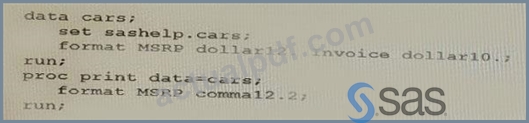
What will be the format for MSRP in the RPOC PRINT output?
- A. Comma12. 2
- B. Dollar10.
- C. Dollar12.
- D. There is a syntax error in the FORMAT statement in the PROC PRINT step.
Answer: C
NEW QUESTION # 41
Which LIBNAME statement has the correct syntax for accessing SAS data sets?
- A. libname mydata='c:\sas\data';
- B. libname 'c:\sas\data'=mydata;
- C. libname mydata 'c:\sas\data';
- D. libname 'c:\sas\data' mydata;
Answer: B
NEW QUESTION # 42
Given the program below: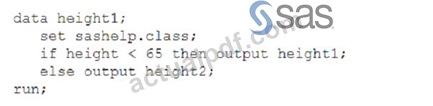
Why does the program fail?
- A. You cannot use numbers in data set names.
- B. You must use two different DATA statements for HEIGHT1 and HEIGHT2
- C. You cannot output to different data sets
- D. You must include the data set height2 in the DATA statement
Answer: D
Explanation:
The program fails because option C is correct: you must include the dataset height2 in the DATA statement.
The DATA step is trying to write to a dataset named height2, which has not been defined in the DATA statement. The correct syntax to create two datasets in one DATA step is to list them both in the DATA statement like so:
data height1 height2;
The use of numbers in dataset names is not a problem in SAS, nor is outputting to different data sets within a single DATA step. Additionally, using two different DATA statements for HEIGHT1 and HEIGHT2 is not required and is not the cause of the failure.
References:
* SAS documentation on the DATA statement and creating multiple data sets.
NEW QUESTION # 43
Which PROC PRINT option displays variable labels in the report?
- A. SHOWLABELS
- B. COLS
- C. LABELS=
- D. LABEL
Answer: C
NEW QUESTION # 44
The data set Snacks contains three variables (productName, Flavor, and Price). Given the program shown below: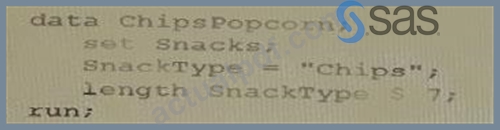
What is the type and length of SnackType?
- A. Character, 8
- B. Character, 5
- C. Character, 7
- D. Numeric, 8
Answer: D
NEW QUESTION # 45
Given the input data set WORK. GR_ANS with two character variables: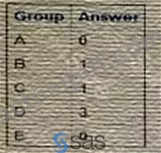
The following SAS program is submitted:
Which report is created?
- A.
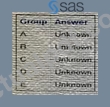
- B.

- C.
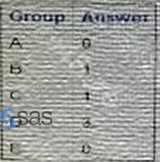
- D.
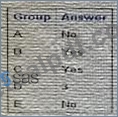
Answer: C
Explanation:
The SAS program provided includes a PROC FORMAT step that defines a numeric format called Syn and applies this format to the variable answer in the PROC PRINT step. The format maps the value '0' to 'No', '1' to 'Yes', and all other values to 'Unknown'.
However, there is a syntax error in the PROC FORMAT step: it uses a dollar sign before Syn, which is used to indicate character formats, but the format is defined for numeric values (0 and 1). Therefore, when applying this format to the answer variable in PROC PRINT, it should not have a dollar sign, it should be format answer Syn.; instead of format answer $yn.;.
The correct output based on the given code, assuming the error with the dollar sign is corrected, would be as follows:
* For numeric values 0 and 1, 'No' and 'Yes' would be displayed, respectively.
* For any other numeric value, 'Unknown' would be displayed.
* For character values, the format would not apply and the actual values would be displayed.
Given that the values in the 'answer' column are numeric, the program will format them according to the defined Syn format. Thus, the report corresponding to Option D, which shows numeric values unformatted, would be the one created. This indicates that the format was not applied because of the syntax error with the dollar sign.
References:
* SAS 9.4 documentation for the FORMAT procedure and statement: SAS Help Center: PROC FORMAT
NEW QUESTION # 46
Given the SAS data set WORK PRODUCTS: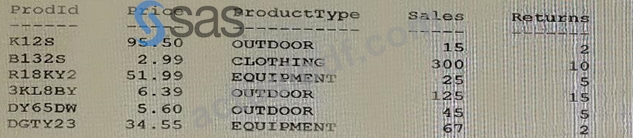
The following SAS program is submitted:
How many variables does the WORK REVENUE data set contains?
- A. 0
- B. 1
- C. 2
- D. 3
Answer: A
NEW QUESTION # 47
Which LIBNAME statement has the correct syntax for accessing SAS data sets?
- A. libname mydata 'c:\sas\data';
- B. libname mydata='c:\sas\data';
- C. libname 'c:\sas\data'=mydata;
- D. libname 'c:\sas\data' mydata;
Answer: A
Explanation:
The correct syntax for the LIBNAME statement in SAS, which assigns a libref to a library stored at a specific path, requires the libref to come first, followed by the path enclosed in quotes. The format is libname libref ' path';. Thus, the correct syntax among the options provided is Option B: libname mydata 'c:\sas\data';. This statement assigns the libref 'mydata' to the directory 'c:\sas\data'. The other options either invert the order of the libref and path or improperly use the equals sign, which is not standard syntax for the LIBNAME statement.
References:SAS documentation on the LIBNAME statement, SAS Institute.
NEW QUESTION # 48
Given the data sets AMERICIAN NATIONAL and results in the data set BASEBALL shown below: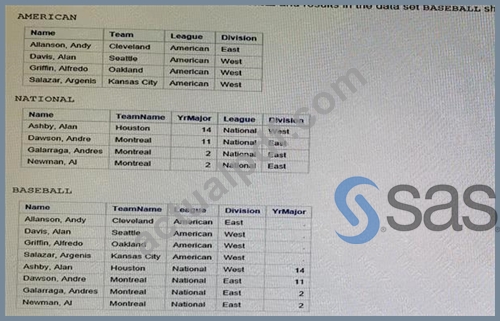
Which DATA step correctly creates the BASEBALL data set?
- A. data baseball;
set national American;
run; - B. data baseball;
set american (rename=(Team=TeamName)) national;
run; - C. data baseball;
set american national;
run; - D. data baseball;
set American (rename=(TeamName=Team)) national;
run;
Answer: C
Explanation:
The correct answer is B. The set statement in SAS can concatenate multiple datasets together. The AMERICAN and NATIONAL datasets appear to have the same structure and variables, so the set statement without any options will combine them into one dataset called BASEBALL. The order of the datasets in the set statement determines the order of the observations in the output dataset, and since there is no variable that needs renaming to match between the two datasets, option B is the correct answer.
References:
* SAS documentation on the set statement.
NEW QUESTION # 49
Which statement is true regarding a variable?
- A. A character variable can contain alphabetic characters, numeric digits, and other special characters.
- B. A character value cannot exceed 200 bytes.
- C. A numeric variable can contain digits, decimal point, minus sign, currency symbol, and E for scientific notation.
- D. A numeric value must be specified in single or double quotes.
Answer: A
Explanation:
In SAS, character variables are indeed capable of holding alphabetic characters, numeric digits, and other special characters, which makes Option A the correct answer. This flexibility allows for storing a wide range of data as text, including combinations that may include symbols and numbers typically found in addresses, identification codes, or textual data that includes special characters. Unlike numeric variables, character variables do not interpret the data as numbers but as literal strings of characters. Options B, C, and D contain inaccuracies regarding how data types and values are treated in SAS. Specifically, numeric values in SAS are never enclosed in quotes (which contradicts B), character variables can exceed 200 bytes depending on the specific declaration (contradicting C), and while numeric variables can indeed include numbers, decimal points, minus signs, and scientific notation, they do not typically include currency symbols as part of the variable's numeric value (contradicting D).
References:SAS documentation on data types, SAS Institute.
NEW QUESTION # 50
Given the partial shown below: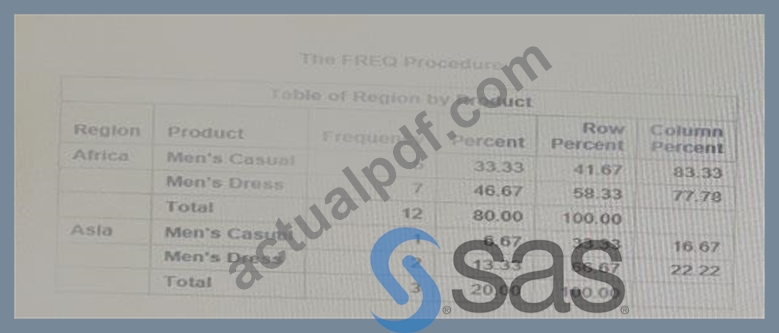
Which step will produce this report?
- A. proc freq data=sashelp.shoes;
tables region*producc / cross run; - B. proc freq data=sashelp.shoes order=freq;
tables region*product / list;
run; - C. proc freq data= sashelp, shoes order=freq;
table region product / crosalist
run; - D. proc freq data=sashelp. shoes
data=sashelp.shoes; region product / list
run;
Answer: C
NEW QUESTION # 51
Which PROC PRINT statement controls the order of the variables displayed in the report?
- A. KEEP
- B. VAR
- C. DROP
- D. SELECT
Answer: B
Explanation:
In PROC PRINT, the VAR statement is used to control the order of the variables displayed in the report. You can list the variables in the order you want them to appear. The KEEP statement can control which variables appear, but not their order. DROP and SELECT are not valid statements within PROC PRINT for controlling the order of variables.
References
* SAS documentation for PROC PRINT.
NEW QUESTION # 52
Given the code shown below: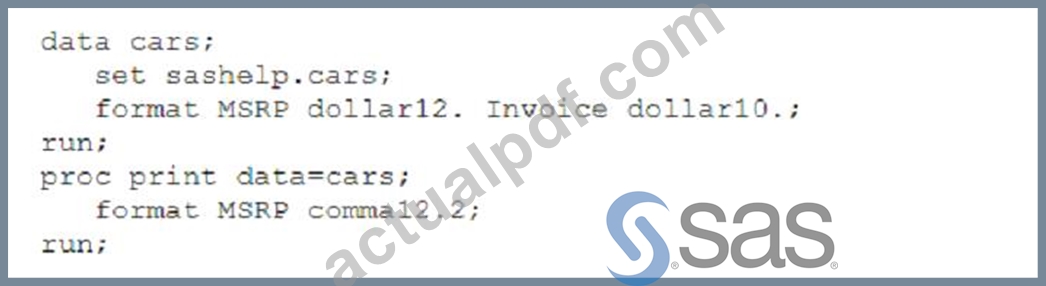
What will be the format for MSRP in the RPOC PRINT output?
- A. Comma12. 2
- B. Dollar10.
- C. There is a syntax error in the FORMAT statement in the PROC PRINT step.
- D. Dollar12.
Answer: A
Explanation:
The FORMAT statement in the DATA step assigns formats to variables for the SAS dataset being created. In the code provided, MSRP is given the dollar12. format and Invoice is given the dollar10. format. However, during the PROC PRINT step, MSRP is reassigned to the comma12.2 format. The format specified in the most recent PROC step or DATA step that executes is the one that is used in the output.
Therefore, the format for MSRP in the PROC PRINT output will be comma12.2, making the answer: B.
Comma12.2
References:
* SAS documentation on PROC PRINT and FORMAT statement, SAS Institute.
NEW QUESTION # 53
Which option renames the variable Name to StudentName when reading the ClassRoster data set?
- A. set ClassRoster (rename (StudentName=Name ) ) ;
B set ClassRoster (rename (NamestudentName) ) ; - B. set ClassRoster (renaiae=(Name=studentName) ) ;
- C. set ClassRoster (^name=(StudentName=Name));
Answer: A
Explanation:
To rename a variable when reading a dataset in SAS, you use the rename= option inside the parentheses following the dataset's name in the set statement. The correct syntax for renaming the variable 'Name' to
'StudentName' is: rename=(oldname=newname). Therefore, the correct option is A, which correctly places the old variable name 'Name' first, followed by an equal sign, and then the new variable name 'StudentName'.
The parentheses enclose the rename operation, and it is correctly nested within the set statement.
References:
* SAS documentation on the RENAME= data set option, SAS Institute.
NEW QUESTION # 54
Which two data sets are permanent?
- A. New
- B. Work.new
- C. Mylib.new
- D. Temp.new
Answer: B
NEW QUESTION # 55
Which statement is true regarding a variable?
- A. A character value cannot exceed 200 bytes.
- B. A character variable can contain alphabetic characters, numeric digits, and other special characters.
- C. A numeric variable can contain digits, decimal point, minus sign, currency symbol, and E for scientific notation.
- D. A numeric value must be specified in single or double quotes.
Answer: A
NEW QUESTION # 56
......
SASInstitute A00-215 Certification Exam is designed to test the knowledge and skills of individuals in areas such as programming, data manipulation, data analysis, and reporting techniques using SAS 9.4. A00-215 exam consists of 65 multiple-choice and short-answer questions that cover various topics such as SAS programming basics, SAS data sets, data cleaning and preparation, and statistical procedures. A00-215 exam is conducted online and can be taken at any time.
Valid A00-215 Exam Dumps Ensure you a HIGH SCORE: https://dumpstorrent.actualpdf.com/A00-215-real-questions.html
