

View All AB-731 Actual Exam Questions Answers and Explanations for Free May-2026
The Most In-Demand Microsoft AB-731 Pass Guaranteed Quiz
Microsoft AB-731 Exam Syllabus Topics:
| Topic | Details |
|---|---|
| Topic 1 |
|
| Topic 2 |
|
| Topic 3 |
|
NEW QUESTION # 13
Hotspot Question
For each of the following statements, select Yes if the statement is true. Otherwise, select No.
NOTE: Each correct selection is worth one point.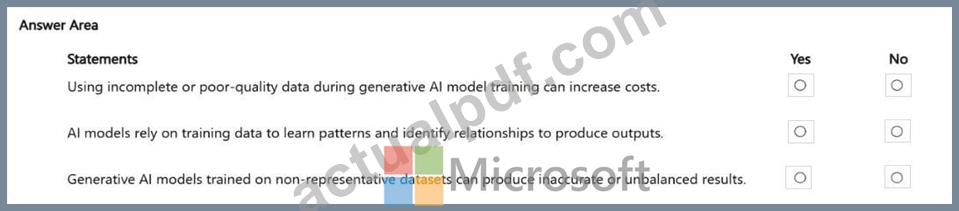
Answer:
Explanation: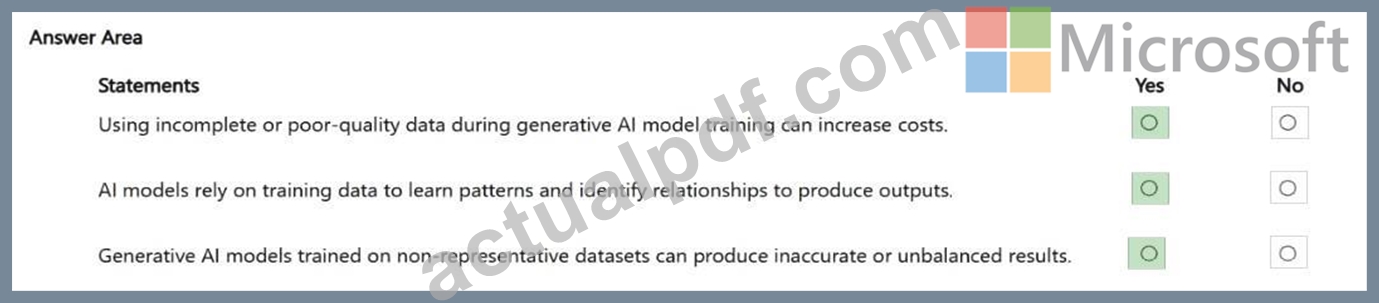
Explanation:
Box 1: Yes
Yes - Using incomplete or poor-quality data during generative AI model training can increase costs.
Using incomplete or poor-quality data during generative AI (GenAI) model training significantly increases costs, acting as a major cause of project failure and inefficiencies. This phenomenon is driven by the "garbage in, garbage out" principle, where flawed inputs lead to, at best, unreliable outputs and, at worst, extensive, costly, and time-consuming remediation.
Box 2: Yes
Yes - AI models rely on training data to learn patterns and identify relationships to produce outputs.
At their core, AI models function like pattern-recognition engines; they don't "know" things in the human sense, but rather calculate the statistical likelihood of what should come next based on the data they've processed.
The quality and variety of that training data directly dictate how nuanced and accurate those relationships become. This is why we see such a massive leap between models trained on small, specific datasets versus Large Language Models (LLMs) trained on the vast diversity of the internet.
Box 3: Yes
Yes - Generative AI models trained on non-representative datasets can produce inaccurate or unbalanced results.
When generative AI models are trained on non-representative datasets, they often inherit and amplify existing societal prejudices, leading to systematic distortions known as representation bias. These models fail to generalize fairly across broader populations, resulting in outputs that marginalize or inaccurately depict minority groups.
NEW QUESTION # 14
Your company plans to use generative AI to help project managers and engineers work with construction blueprints stored as PDF files.
You need to recommend a generative AI solution that meets the following business requirements:
- Processes both images and text
- Summarizes the design of a building
- Answers user questions about a building's design
- Extracts information from blueprints, such as the location of
electrical, heating, and plumbing systems
What should you recommend?
- A. a multi-modal solution
- B. an optical character recognition (OCR) solution
- C. a text completion solution
- D. a document summarization solution
Answer: D
Explanation:
A Multimodal Generative AI document summarization solution (or Multimodal Large Language Model, MLLM), which integrates advanced computer vision and text analysis to process complex engineering, architectural, or design documents.
These solutions go beyond simple text extraction by interpreting the spatial relationships and visual cues in technical drawings.
Key Capabilities
Multimodal Processing (Text & Images): These systems ingest PDFs, CAD drawings, or scanned images of blueprints. They simultaneously analyze textual specifications and visual layout, such as P&ID (Piping & Instrumentation Diagrams).
Summarizing a Design: AI can condense long technical reports, specifications, and accompanying blueprints into concise summaries, highlighting key design choices, materials, or project goals.
Answering User Questions: Because they understand the context of the document, these systems act as an intelligent assistant, allowing users to ask, "What is the material for pipe A?" or
"Where is the control panel located?" and receive answers extracted from the blueprints.
Extracting Information (Subsystem Locations): Advanced AI can automatically identify, segment, and annotate key elements in drawings. This includes recognizing specific subsystems, components (pumps, valves), and their exact locations within the design.
Identifying Discrepancies: These tools can perform "clash detection" or compare initial and revised blueprints, highlighting changes in subsystem locations that might cause issues.
Reference:
https://www.eng.it/en/insights/stories/case-studies/genai-per-estrazione-dati-da-disegni-tecnici
NEW QUESTION # 15
- Select the answer that correctly completes the sentence.
Using high-quality grounding data in a generative AI solution __________.
Answer:
Explanation:
Explanation:
improves the accuracy and reliability of the predictions and outputs of AI.
High-quality grounding data improves a generative AI solution by anchoring responses to trusted, relevant, and up-to-date information , which increases the likelihood that outputs are accurate, consistent, and aligned with the organization's expectations. This is why the best completion is " improves the accuracy and reliability of the predictions and outputs of AI ." When the model is given authoritative context (for example, approved policy text, product specifications, knowledge base articles, or controlled enterprise content), it has less need to "guess" based on general patterns in its training data. That reduces hallucinations and improves response relevance to the user's question and the business domain.
It does not "ensure that all responses are factually accurate" because grounding reduces errors but cannot eliminate them completely-retrieval can return incomplete or irrelevant passages, user prompts can be ambiguous, and the model can still misinterpret context. It also does not inherently "increase performance of an AI model" in the sense of speed/throughput or model capability; grounding is an architecture and data strategy that improves output quality, not compute efficiency. Finally, grounding is not about "increasing storage required to host an AI model." While you may store documents in an index or repository, the core benefit is improved response quality through better context, not larger model hosting requirements.
NEW QUESTION # 16
Hotspot Question
For each of the following statements, select Yes if the statement is true. Otherwise, select No.
NOTE: Each correct selection is worth one point.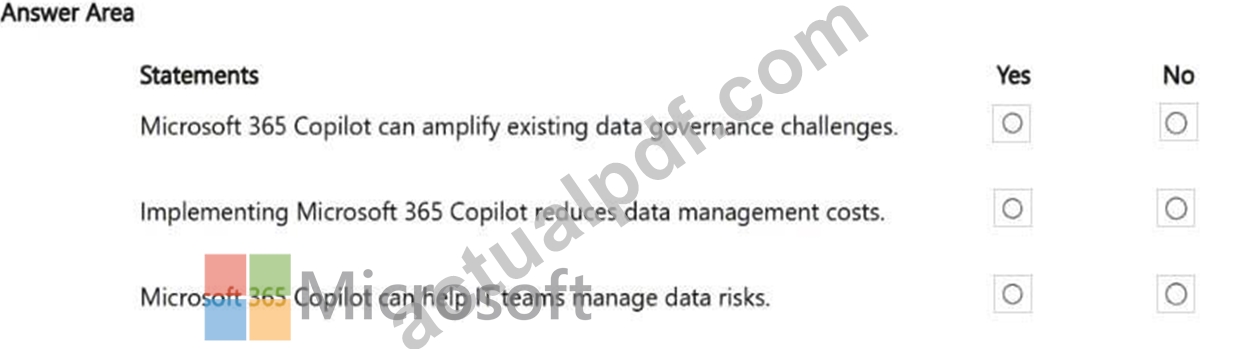
Answer:
Explanation: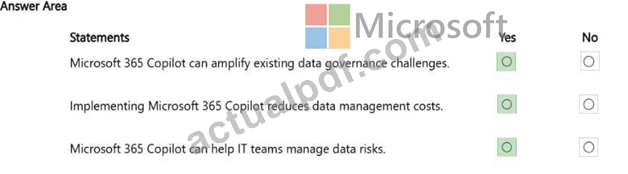
Explanation:
Box 1: Yes
Yes - Microsoft 365 Copilot can amplify existing data governance challenges.
Microsoft 365 Copilot significantly amplifies existing data governance, security, and compliance challenges within organizations, primarily because it operates by accessing data based on a user's existing permissions. If an organization has weak data hygiene or "permission sprawl"- where employees have access to more information than necessary-Copilot can instantly surface sensitive, confidential, or obsolete data, making oversharing a critical, high-speed risk.
Box 2: Yes
Yes - Implementing Microsoft 365 Copilot reduces data management costs.
Implementing Microsoft 365 Copilot can significantly reduce data management and operational costs by streamlining workflows, automating routine tasks, and improving data hygiene.
Organizations, such as Kantar, have used it to reduce storage costs by identifying and archiving inactive data while enhancing the relevance of information Copilot accesses.
Box 3: Yes
Yes - Microsoft 365 Copilot can help IT teams manage data risks.
Microsoft 365 Copilot includes built-in security, privacy, and compliance capabilities that empower IT teams to manage data risks, particularly by enforcing existing data access policies and integrating with Microsoft Purview. It ensures that Copilot only accesses data that a user is authorized to view based on their existing Microsoft 365 permissions, thereby preventing unauthorized data exposure.
Reference:
https://securiti.ai/copilot-governance-best-practices
https://techcommunity.microsoft.com/blog/microsoft_365blog/kantar-reduces-storage-costs-with- microsoft-365-archive/4494597
https://learn.microsoft.com/en-us/copilot/microsoft-365/microsoft-365-copilot-ai-security
NEW QUESTION # 17
Hotspot Question
For each of the following statements, select Yes if the statement is true. Otherwise, select No.
NOTE: Each correct selection is worth one point.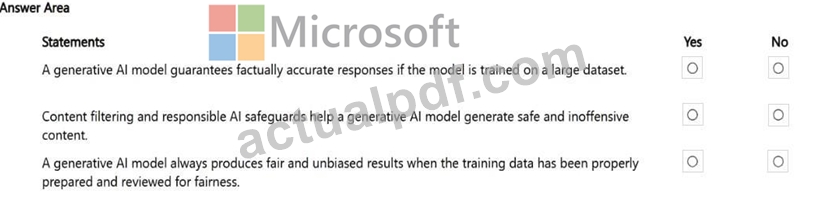
Answer:
Explanation: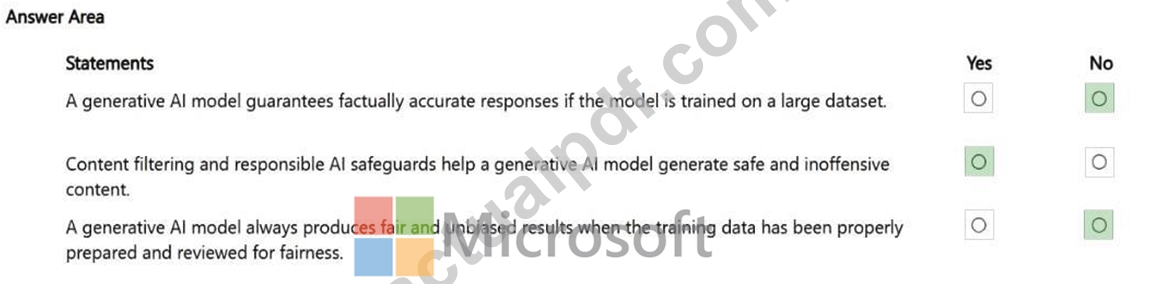
Explanation:
Box 1: No
No - A generative AI model guarantees factually accurate responses if the model is trained on a large dataset.
A large training dataset does not guarantee that a generative AI model will provide factually accurate responses. While larger, diverse datasets generally improve performance and reduce certain types of errors, they do not eliminate the fundamental tendency of these models to generate incorrect information, known as "hallucinations".
Box 2: Yes
Yes - Content filtering and responsible AI safeguards help a generative AI model generate safe an inoffensive content.
Content filtering and responsible AI safeguards (e.g., in Azure AI Foundry or Amazon Bedrock ) act as essential, multi-layered, reactive mechanisms-covering both input and output-to detect and block harmful, illegal, or biased content. These systems use automated classifiers to, for example, filter for hate speech, sexual content, violence, and self-harm. They ensure safety by analyzing prompts and generating responses, often allowing for custom thresholds, to prevent models from generating unsafe or inappropriate output.
Box 3: No
No - A generative AI model always produce fair and unbiased results when the training data has been properly prepared and reviewed for fairness.
Even with perfectly prepared and reviewed training data, generative AI models can still produce biased results. While high-quality data is foundational, bias is a persistent challenge that can emerge from multiple sources throughout the AI lifecycle.
Reference:
https://mehmetozkaya.medium.com/limitations-of-large-language-models-llms-1790a14010db
https://monowar-mukul.medium.com/keeping-your-ai-safe-content-filters-in-azure-ai-foundry-
9a87c8447e11
https://www.sap.com/resources/what-is-ai-bias
NEW QUESTION # 18
- Select the answer that correctly completes the sentence.
When you use Microsoft 365 Copilot connectors to connect external content to __________, your users can find, summarize, and learn from line-of-business (LOB) data by using natural language prompts.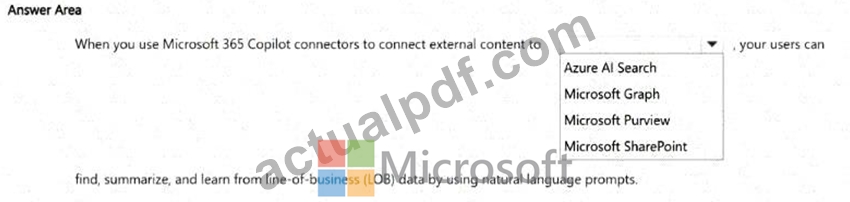
Answer:
Explanation: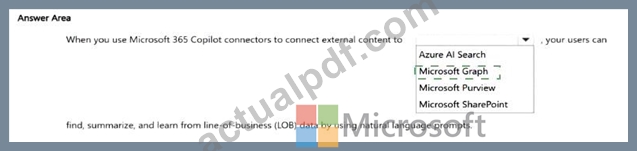
Explanation:
Microsoft Graph
Microsoft 365 Copilot connectors (built on Microsoft Graph connectors) are used to bring external, line-of- business content into the Microsoft 365 ecosystem by ingesting it into Microsoft Graph . Once connected, the content can be indexed and made discoverable through Microsoft Search and available for Copilot experiences, enabling users to use natural language prompts to find and summarize relevant LOB information-subject to permissions and governance controls.
The other choices don't match how Copilot connectors are positioned. Azure AI Search is an Azure indexing
/retrieval service used in custom RAG solutions, but Microsoft 365 Copilot connectors are specifically designed to surface external content through Microsoft 365 experiences via Graph. Microsoft Purview focuses on data governance, compliance, and risk management rather than being the primary ingestion target for Copilot connector content. SharePoint can store content, but the connector model is about indexing external systems into Microsoft Graph so the content becomes searchable and usable across Microsoft 365, not merely placing it into SharePoint as the destination.
So the correct completion is Microsoft Graph because that is the foundational data and indexing fabric Copilot uses to reason over organizational content with appropriate permission trimming.
NEW QUESTION # 19
- Select the answer that correctly completes the sentence.
The Analyst agent in Microsoft 365 Copilot __________.
Answer:
Explanation:
Explanation:
uses structured data and provides insights by using text, charts, tables, and other visuals.
The Analyst agent in Microsoft 365 Copilot is positioned as a "data analysis" reasoning agent that helps users work through structured information (for example, tables, spreadsheets, and other dataset-like inputs) and then produces analytical outputs . The best completion is the option stating it "uses structured data and provides insights by using text, charts, tables, and other visuals," because that describes the hallmark outcome of analyst-style work: summarizing patterns, highlighting key drivers, and presenting results in formats that business users can act on. Analyst-style assistance typically includes exploring the data, identifying trends and anomalies, comparing segments, and explaining findings clearly-often accompanied by tables and visual representations that make the insights easier to consume.
The other dropdown options align to different use cases: "compiles background research for a new market or initiative" describes a research-oriented agent, "generate audio summaries" is a media summarization function, and "answer employee FAQs" describes a conversational knowledge assistant. Analyst is the one most directly associated with structured-data interpretation and producing a mix of narrative plus analytical artifacts (tables/charts) to communicate conclusions.
NEW QUESTION # 20
Hotspot Question
For each of the following statements, select Yes if the statement is true. Otherwise, select No.
NOTE: Each correct selection is worth one point.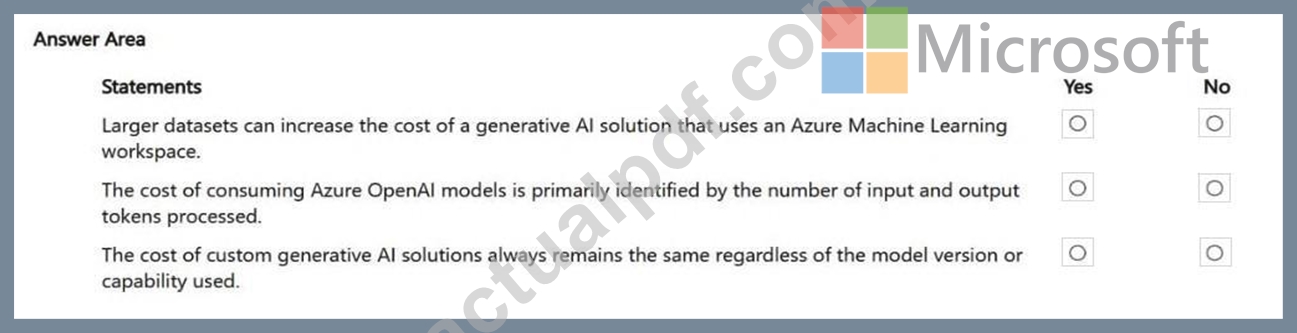
Answer:
Explanation: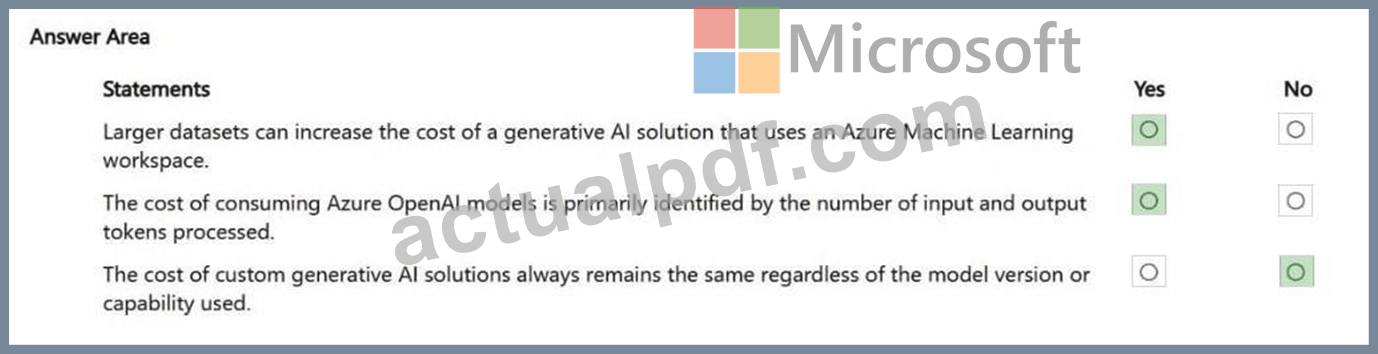
Explanation:
Box 1: Yes
Yes - Larger datasets can increase the cost of generative AI solution that uses an Azure Machine Learning workspace.
larger datasets can increase the cost of a generative AI solution using an Azure Machine Learning (AML) workspace. While the AML workspace itself has no additional charge, larger datasets increase expenses across several underlying Azure services, particularly through higher storage, compute, and data transfer requirements.
Box 2: Yes
Yes - The cost of consuming Azure OpenAI models is primarily identified by the number of input and output tokens processed.
The cost of consuming Azure OpenAI models is primarily determined by the number of input and output tokens processed.
This consumption-based, pay-as-you-go model calculates costs based on the total volume of text (or image/audio data) sent to the model (input) and the text generated by the model (output), usually billed per 1,000 or 1 million tokens, depending on the model and pricing page updates.
Box 3: No
No - The cost of custom generative AI solutions always remains the same regardless of the model version or capability used he cost of custom generative AI solutions varies significantly based on the model's version, complexity, and capability. While a basic chatbot might range from $40,000 to $150,000, advanced enterprise-grade platforms with high-risk reasoning can exceed $400,000 to
$500,000+.
Reference:
https://www.doit.com/blog/optimizing-ml-costs-with-azure-machine-learning
https://www.finout.io/blog/azure-openai-pricing
https://medium.com/@dejanmarkovic_53716/custom-ai-solutions-cost-guide-2025-pricing- insights-revealed-cf19442261ec
NEW QUESTION # 21
Your company plans to use generative AI to help project managers and engineers work with construction blueprints stored as PDF files. You need to recommend a generative AI solution that processes both images and text, summarizes building design, answers questions, and extracts information such as locations of electrical, heating, and plumbing systems. What should you recommend?
- A. a document summarization solution
- B. a multi-modal solution
- C. a text completion solution
- D. an optical character recognition OCR solution
Answer: B
Explanation:
Construction blueprints in PDFs often contain a mix of text, symbols, linework, and diagrams . The requirements include understanding both visual layout (where systems are located) and textual annotations , producing summaries, and answering Q & A. That combination requires a multimodal generative AI approach-models that can reason over images and text together. Therefore, A is best.
OCR alone (B) can extract printed text, but it won't reliably interpret diagram geometry, symbols, or spatial relationships (e.g., "electrical riser is on the east core near gridline B-4"). Text completion (C) is too generic and doesn't address image understanding. Document summarization (D) is only one requirement (summary) and still depends on first extracting/understanding both visual and textual elements.
A multimodal solution can ingest the PDF pages as images (or rendered page images) plus extracted text, then answer questions grounded in both modalities. In practice, you may combine OCR and layout extraction with a multimodal LLM so the model can reference drawing regions, legends, callouts, and system diagrams to produce accurate explanations and field extractions.
NEW QUESTION # 22
Hotspot Question
For each of the following statements, select Yes if the statement is true. Otherwise, select No.
NOTE: Each correct selection is worth one point.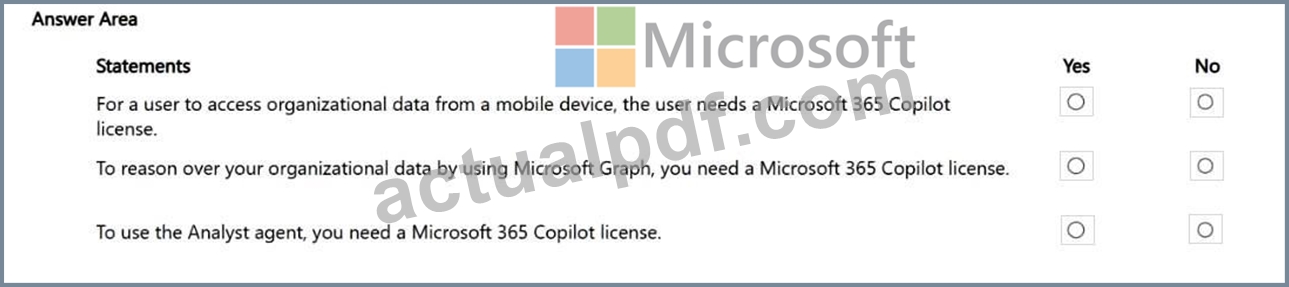
Answer:
Explanation: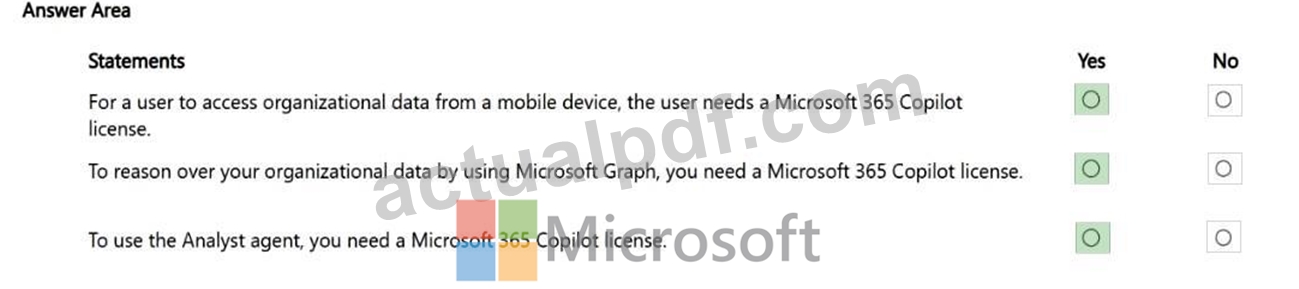
Explanation:
Box 1: Yes
Yes - For a user to access organizational data from a mobile device, the user needs a Microsoft
365 Copilot license.
To access, summarize, and query organizational data (such as emails, chats, documents in SharePoint/OneDrive, and calendar items) via Microsoft 365 Copilot on a mobile device, a user must have a Microsoft 365 Copilot license assigned to them.
This license is an add-on to a qualifying base subscription (such as Microsoft 365 E3, E5, Business Standard, or Business Premium).
Box 2: Yes
Yes - To reason over your organizational data by using Microsoft Graph, you need a Microsoft
365 Copilot license.
To use the advanced AI reasoning capabilities of Microsoft 365 Copilot-specifically to analyze, summarize, and query your organizational data (emails, chats, documents, meetings) via Microsoft Graph-you need a Microsoft 365 Copilot license.
Box 3: Yes
Yes - To use the Analyst agent, you need a Microsoft 365 Copilot license To use the Analyst agent, you generally need a Microsoft 365 Copilot add-on license.
While a basic version of Copilot Chat is available for many Microsoft 365 and Office 365 subscribers at no extra cost, advanced "Frontier" agents like Analyst and Researcher are specifically built for deep reasoning and multi-step tasks, which are reserved for licensed Copilot users.
Reference:
https://learn.microsoft.com/en-us/copilot/microsoft-365/microsoft-365-copilot-minimum- requirements
https://learn.microsoft.com/en-us/copilot/faq
https://it.osu.edu/news/2025/07/22/new-microsoft-365-copilot-agents-available-research-and- analysis
NEW QUESTION # 23
You are exploring how Microsoft 365 Copilot uses Microsoft Graph to deliver AI-powered experiences.
Which information in Microsoft Graph can Copilot use by default?
- A. social media activity
- B. content from public websites
- C. data stored in a file share
- D. emails, files, meetings, and chats in Microsoft 365
Answer: D
Explanation:
Microsoft 365 Copilot is designed to act as an AI-powered assistant that leverages Microsoft Graph to access your organization's data, including emails, files, chats, and meetings. By default, Copilot integrates with Microsoft 365 apps and uses this data to provide contextually relevant, real-time assistance.
Key Capabilities via Microsoft Graph
*-> Data Access: Copilot retrieves information from emails, files (OneDrive/SharePoint), meetings (Teams transcripts), and chats.
Grounding: It uses this data to "ground" prompts, providing responses that are specific to your actual work rather than general information.
Semantic Indexing: Copilot creates a semantic index of your Graph data to understand relationships and intent, making search and retrieval more accurate.
Reference:
https://learn.microsoft.com/en-us/copilot/microsoft-365/enterprise-data-protection
NEW QUESTION # 24
For each of the following statements, select Yes if the statement is true. Otherwise, select No. NOTE: Each correct selection is worth one point.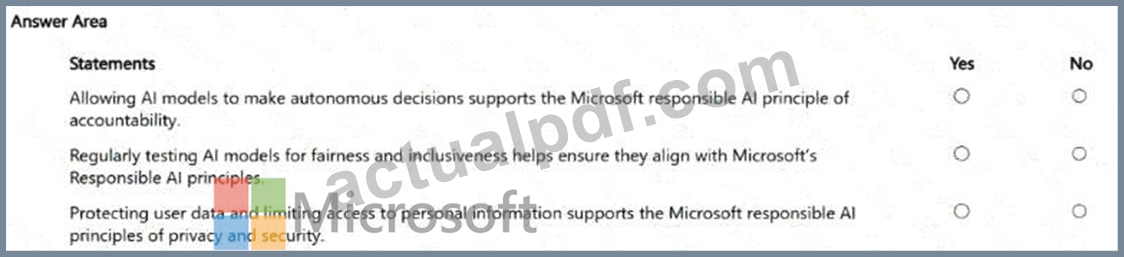
Answer:
Explanation: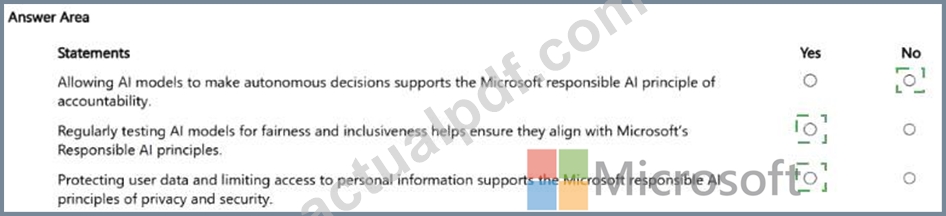
Explanation:
Answer Area
* Allowing AI models to make autonomous decisions supports the Microsoft responsible AI principle of accountability. Answer: No
* Regularly testing AI models for fairness and inclusiveness helps ensure they align with Microsoft's Responsible AI principles. Answer: Yes
* Protecting user data and limiting access to personal information supports the Microsoft responsible AI principles of privacy and security. Answer: Yes Microsoft's Responsible AI principles emphasize that people and organizations must remain accountable for AI systems and their outcomes. Accountability is strengthened by governance, human oversight, clear ownership, auditability, and processes to review and address issues-not by letting models make unchecked autonomous decisions. Therefore, statement 1 is No : increasing autonomy can actually increase risk unless paired with human-in-the-loop controls and clear escalation paths, because accountability requires clear responsibility for decisions and impacts.
Statement 2 is Yes because fairness and inclusiveness are explicitly supported through ongoing evaluation.
Regular testing helps detect disparate impact, performance gaps across user groups, and unintended bias introduced by data drift or changes in usage patterns. It's not a one-time activity; it's continuous assurance that the system behaves appropriately as conditions change.
Statement 3 is Yes because privacy and security are directly supported by protecting personal/sensitive data, enforcing least privilege access, and implementing controls such as data loss prevention, encryption, access logging, and strong identity governance. Limiting access to personal information reduces exposure and supports compliance obligations while aligning with privacy-by-design and secure-by-design expectations for AI-enabled solutions.
NEW QUESTION # 25
Your company is preparing to adopt Microsoft 365 Copilot and wants to follow Microsoft responsible AI principles.
As a business leader, you propose establishing an AI governance council to ensure alignment with the responsible AI principles.
What is the primary purpose of the council? More than one answer choice may achieve the goal.
Select the BEST answer.
- A. to monitor user behavior and enforce compliance with internal IT policies
- B. to train employees on how to use Copilot features effectively
- C. to oversee implementation, manage technical performance, and ensure successful AI deployment
- D. to guide strategy, provide oversight, and ensure cross-functional alignment for responsible AI adoption
Answer: D
Explanation:
Establishing an AI Governance Council is a critical step for organizations adopting Microsoft 365 Copilot to ensure that AI initiatives remain safe, ethical, and strategically aligned. This multidisciplinary body acts as the "operating system" for trustworthy AI, bridging the gap between technical teams and executive leadership.
Core Responsibilities of the Council
The council typically oversees the entire AI lifecycle across several key areas:
*-> Strategic Guidance: Aligning AI adoption with business goals and defining the organization's AI vision and acceptable use policies.
Ethical Oversight: Ensuring all solutions adhere to responsible AI principles such as fairness, transparency, and accountability.
Risk Management: Identifying and mitigating potential harms, including data leakage, algorithmic bias, and regulatory non-compliance.
*-> Cross-Functional Alignment: Bringing together stakeholders from IT, Legal, HR, Compliance, and individual business units to prevent siloed decision-making.
Policy Enforcement: Approving specific high-risk use cases and overseeing the implementation of technical guardrails like Microsoft Purview for data classification and protection.
Reference:
https://learn.microsoft.com/en-us/azure/cloud-adoption-framework/scenarios/ai/strategy
https://adoption.microsoft.com/files/copilot/LeadingintheEraofAI_%20CreatinganAICouncil_Mar20
24.pdf
NEW QUESTION # 26
Hotspot Question
For each of the following statements, select Yes if the statement is true. Otherwise, select No.
NOTE: Each correct selection is worth one point.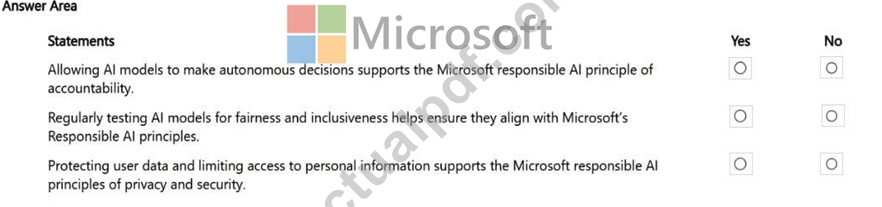
Answer:
Explanation: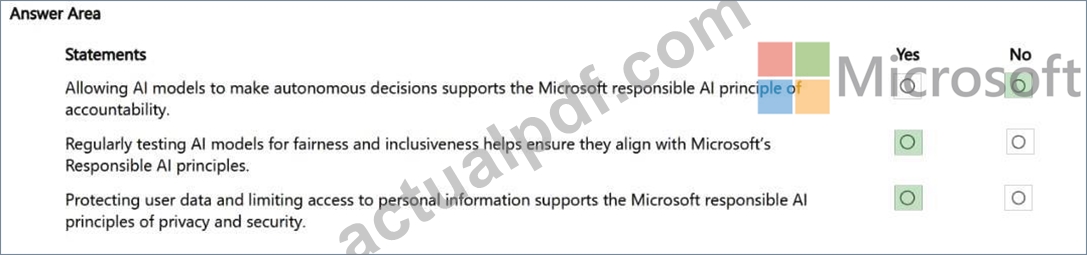
Explanation:
Box 1: No
No - Allowing AI models to make autonomous decisions support Microsoft AI principle of accountability.
Microsoft's principle of accountability actually mandates that humans, not AI models, remain the final authority for how a system operates. While AI can perform automated tasks, the accountability principle requires that the people who design and deploy these systems take responsibility for their impact and maintain meaningful control.
Box 2: Yes
Yes - Regularly testing AI models for fairness and inclusiveness helps ensure they align with Microsoft's Responsible AI principles.
Regularly testing AI models for fairness and inclusiveness is a foundational practice within Microsoft's Responsible AI Standard, which acts as a guide for developing and deploying AI systems. This continuous testing ensures that AI applications do not reinforce historical biases and perform equitably across different demographic groups, including race, gender, age, and background.
Box 3: Yes
Yes - Protecting user data and limiting access to personal information supports the Microsoft responsible AI principles of privacy and security.
Protecting user data and limiting access to personal information are, in fact, foundational to Microsoft's Responsible AI principles of Privacy and Security. Microsoft's AI framework mandates that AI systems are developed and deployed in a manner that respects user privacy and maintains strict data security, aiming for AI systems that are "secure by design".
Reference:
https://learn.microsoft.com/en-us/azure/machine-learning/concept-responsible-ai
https://techcommunity.microsoft.com/blog/nonprofittechies/the-importance-of-responsible-ai-a- comprehensive-guide/4404347
NEW QUESTION # 27
Your company sells hiking and camping gear online. You need a generative AI solution that can interact with customers and ask questions about their needs. What should you include in the solution?
- A. a chatbot
- B. predictive AI
- C. computer vision
- D. a recommendation engine
Answer: A
NEW QUESTION # 28
Hotspot Question
For each of the following statements, select Yes if the statement is true. Otherwise, select No.
NOTE: Each correct selection is worth one point.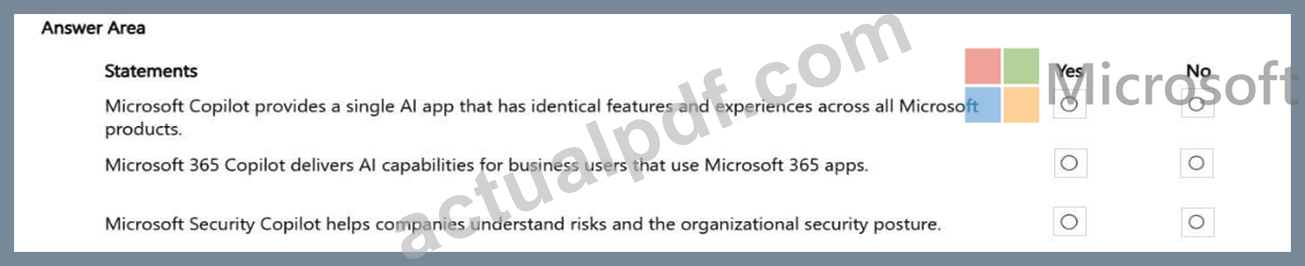
Answer:
Explanation: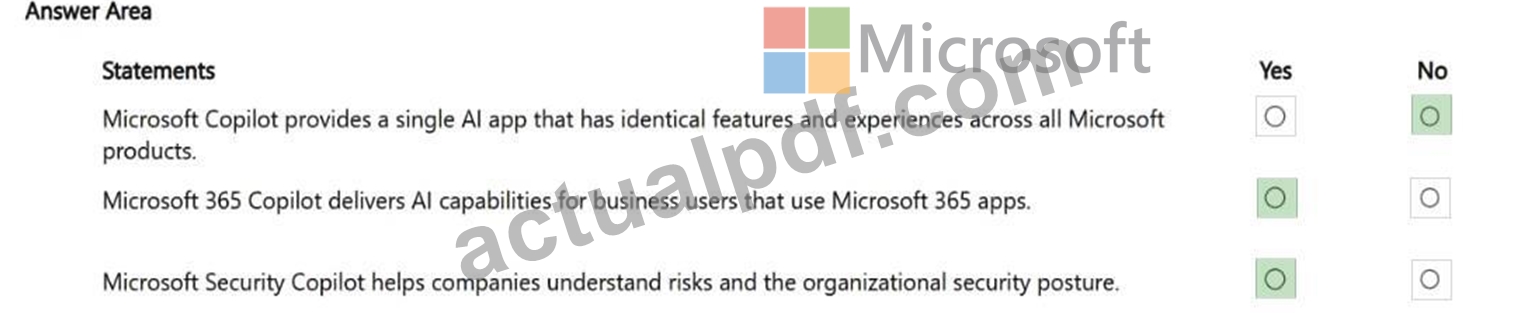
Explanation:
Box 1: No
No - Microsoft 365 Copilot provides a single AI app that has identical features and experiences across all Microsoft products.
Microsoft 365 Copilot is not a single, identical app with uniform features across all Microsoft products. Instead, it is an AI-powered assistant embedded within the existing Microsoft 365 apps (Word, Excel, PowerPoint, Outlook, Teams, etc.), and its capabilities are tailored to the specific functions of each application.
Box 2: Yes
Yes - Microsoft 365 Copilot delivers AI capabilities for business users that use Microsoft 365 apps.
Microsoft 365 Copilot is an AI-powered assistant designed to enhance productivity and collaboration by integrating directly into Microsoft 365 apps, including Word, Excel, PowerPoint, Outlook, and Teams. It acts as a "second pilot" that works alongside users, utilizing Large Language Models (LLMs) and Microsoft Graph to automate routine tasks, draft content, and provide real-time insights based on organizational data.
Box 3: Yes
Yes - Microsoft Security Copilot helps companies understand risks and the organizational security posture.
Microsoft Security Copilot is a generative AI-powered security tool designed to help organizations understand risks, assess their security posture, and accelerate threat response. By integrating with the Microsoft Security portfolio-including Defender XDR, Microsoft Sentinel, and Microsoft Intune-it provides a centralized view of security data and offers natural language, actionable guidance.
Reference:
https://techcommunity.microsoft.com/blog/microsoft365copilotblog/copilot-chat-comes-to-the- microsoft-365-apps/4453349
https://www.quest.com/learn/what-is-microsoft-copilot-for-security.aspx
NEW QUESTION # 29
- What should you use for each task? To answer, select the appropriate options in the answer area. NOTE:
Each correct selection is worth one point.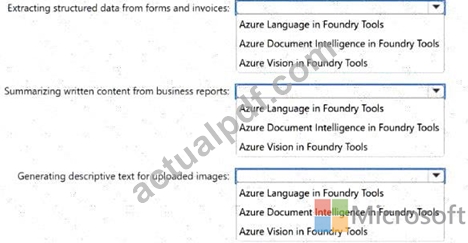
Answer:
Explanation: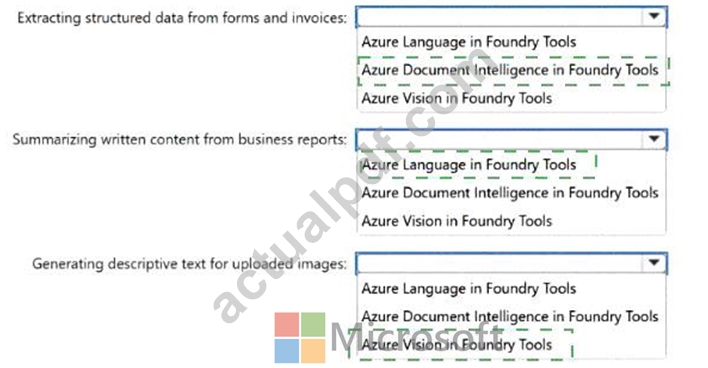
Explanation:
Answer Area
* Extracting structured data from forms and invoices: Answer: Azure Document Intelligence in Foundry Tools
* Summarizing written content from business reports: Answer: Azure Language in Foundry Tools
* Generating descriptive text for uploaded images: Answer: Azure Vision in Foundry Tools These three tasks align to three different Azure AI capability families: document processing, language understanding/generation, and computer vision.
* Forms and invoices are semi-structured documents where the business need is to extract specific fields (IDs, names, totals, dates) reliably into structured output. Azure Document Intelligence is designed for intelligent document processing and includes prebuilt models (such as invoices) as well as custom extraction options, making it the correct choice for structured data extraction from documents.
* Summarizing written business reports is an NLP task focused on compressing long text into key points, themes, and action items. Azure Language provides language processing capabilities (including summarization features within language service capabilities), so it is the best fit for summarization scenarios.
* Generating descriptive text for images (image captioning/description) is a computer vision task.
Azure Vision can analyze uploaded images and return descriptions/captions and other visual insights, which directly matches the requirement to produce descriptive text from images.
NEW QUESTION # 30
Which statement accurately describes the difference between a pretrained generative AI model and a fine- tuned generative AI model?
- A. A pretrained model is trained on broad datasets, while a fine-tuned model is adapted to perform well on a narrower, domain-specific dataset.
- B. A pretrained model is faster to train than a fine-tuned model because the pretrained model uses fewer parameters.
- C. A pretrained model requires labeled data, while a fine-tuned model does not.
- D. A pretrained model is optimized for a specific task, while a fine-tuned model is designed for general-purpose use.
Answer: A
Explanation:
A pretrained generative AI model is trained initially on a large, broad, and diverse dataset so it learns general language (or multimodal) patterns and capabilities. Fine-tuning then takes that pretrained base and performs additional training on a smaller, task- or domain-specific dataset to specialize behavior- improving performance for a particular use case, tone, style, or domain knowledge representation. That is exactly what option C states, making it the correct answer.
Option A is incorrect because both pretraining and fine-tuning may use labeled or unlabeled data depending on the technique; the distinction is not "labeled vs. unlabeled." Option B is incorrect because a pretrained model is not "faster to train" due to fewer parameters; pretraining is typically the most compute-intensive phase precisely because it's done at large scale, while fine-tuning is smaller but still trains the same model architecture. Option D is reversed: the pretrained model is the general-purpose foundation, while the fine- tuned model is the specialized variant for a specific task or dataset.
NEW QUESTION # 31
A marketing team wants to automatically create product descriptions and campaign email drafts.
Which generative AI capability best meets this business need?
- A. Anomaly detection
- B. Predictive demand forecasting
- C. Natural language content generation
- D. Image classification
Answer: C
NEW QUESTION # 32
Your company plans to adopt AI across multiple business units. You need to ensure that all AI projects align with the company's business strategy and are implemented responsibly. What is the best approach to achieve the goal? More than one answer choice may achieve the goal. Select the BEST answer.
- A. Allow each department to deploy its own AI tools and workflows.
- B. Outsource AI development to an external vendor.
- C. Establish an AI council to provide guidance, oversight, and coordination.
- D. Delegate AI decision-making to the company's IT department.
Answer: C
Explanation:
When AI adoption spans multiple business units, the primary risk is fragmented delivery: inconsistent standards, duplicated spend, uneven risk controls, and misalignment with enterprise strategy. Establishing an AI council (D) is the best approach because it creates a cross-functional governance mechanism that aligns AI initiatives to business priorities while enforcing Responsible AI practices consistently.
An AI council typically includes senior stakeholders from business leadership, IT, security, legal, compliance, privacy, data, and HR. Its role is to define AI principles and guardrails, approve high-impact use cases, set policy for data usage and access, establish evaluation and monitoring requirements, and coordinate change management and training. This also enables portfolio management-deciding which projects to prioritize, reuse, or stop-so AI investments map to measurable business outcomes.
The other options are weaker: A encourages siloed deployments and inconsistent risk management. B centralizes too narrowly in IT; Responsible AI requires broader accountability than a single function. C can help delivery capacity but does not replace internal governance; vendors still need direction, controls, and oversight from the organization.
NEW QUESTION # 33
Your company receives thousands of scanned invoices each month.
You need to recommend an AI solution that can automatically extract key details, such as invoice numbers, vendor names, and total amounts.
What is the best solution to recommend? More than one answer choice may achieve the goal.
Select the BEST answer.
- A. Azure Machine Learning
- B. Azure AI Search
- C. Azure Document Intelligence in Foundry Tools
- D. Azure Vision in Foundry Tools
Answer: C
Explanation:
Azure Document Intelligence in Foundry Tools is the preferred solution for automatically extracting structured data-such as vendor names, invoice IDs, and total amounts-from invoices, PDFs, and images. It utilizes advanced AI and OCR to convert unstructured documents into structured JSON data.
Reference:
https://learn.microsoft.com/en-us/azure/ai-services/document-intelligence/prebuilt/invoice
NEW QUESTION # 34
......
AB-731 Free Certification Exam Material with 55 Q&As : https://dumpstorrent.actualpdf.com/AB-731-real-questions.html
